An overview of our sell-side M&A services








How to Build a Durable Software Business
When you’re building a software company, you’re usually focused on what’s right in front of you: winning the next customer, making the next hire, improving the product, hitting the number, and figuring out where to invest next.
It can take years to see how those decisions shape the company you’re building. A business can grow quickly without necessarily becoming stronger, particularly if acquiring customers keeps getting more expensive, existing customers aren’t staying, or the company needs to add people as quickly as it adds revenue.
I learned some of those lessons early while building my own software company. Others took longer, and a few became clear only after an advisor, investor, or buyer asked a question I should have been asking myself.
Over time, I saw that many of the qualities that made our company more durable also made it easier to grow, manage, and eventually sell. You don’t have to know what you want to do with your company someday to benefit from building a stronger business today.
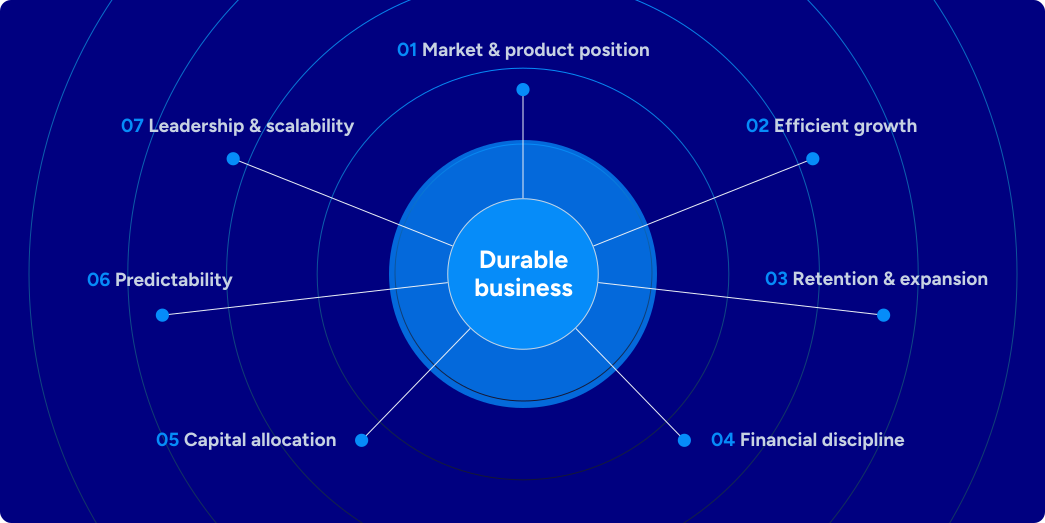
Here are seven areas I’d encourage software founders to focus on as they build.
1. Build a Durable Market and Product Position
A durable software company starts with an important problem and a clear understanding of where it has the strongest right to win.
When we built BigfootCMMS, we weren’t trying to invent a new category of software. We were helping manufacturers manage assets, preventative maintenance, and other work that already needed to get done. The opportunity was to use the latest technology to solve those problems better.
Today, AI has made it faster and easier to build software and add new capabilities. But being able to build something doesn’t mean customers need it or that it gives them another reason to depend on your product.
Keep coming back to a few basic questions:
- What critical problem are you solving for your customers?
- How important is that problem to their business?
- Which customers get the most value from your product?
- Why do they choose you over the alternatives?
- What makes your position difficult for competitors to replicate or displace?
The strongest software companies become part of how their customers operate and grow. Their products sit inside important workflows, accumulate useful context and data, and become increasingly difficult to replace.
That position also depends on your ability to keep improving the product. Technology that becomes difficult to maintain, integrations that no longer meet customer needs, or technical debt that slows development can weaken an otherwise strong business.
Customers may continue using your product because switching is difficult, but that’s not the same as continuing to choose it because it delivers more value than the alternatives.
Getting there requires focus. One of the mistakes I made as a founder was trying to be too many things to too many customers. I was spreading the peanut butter too thin.
It’s an easy trap to fall into. A large customer asks for a new capability, so you build it.
Another wants the product to work differently for its use case, so you adjust the roadmap. A new market looks promising, so you start investing there, too.
Each decision can look reasonable, but make enough of them, and you start dividing people, capital, and attention across too many priorities. The customer is not always right, at least when it comes to your strategy. I learned how easy it is to let the squeaky wheel pull development resources in a new direction because you want to keep an important customer happy.
A proverb says, “If you chase two rabbits, you may catch neither.”
That doesn’t mean ignoring new opportunities. Markets, customer needs, and technology change. Pay attention to those shifts, but understand the difference between an opportunity that strengthens your position and one that pulls you away from it.
Know the customers and problems where you win, understand why you win there, and invest deeply enough to create a position that lasts.
2. Build a Repeatable, Efficient Growth Engine
Revenue growth tells you that you’re adding business. It doesn’t tell you how efficiently you’re producing that growth or whether you can continue producing it as the company gets bigger.
I learned that lesson in a management meeting with a private equity firm that was considering investing in our company. One of the investors was at the whiteboard, asking questions about our sales team. How many salespeople did we have? How much revenue were they producing?
He started doing the math and then stopped. He told us he had never seen a company with such poor per-salesperson metrics.
That was painful to hear, especially since my SEG advisor had been telling me the same thing for months. We had seven salespeople, and he believed we could generate the same results with a much smaller team. I resisted because my team felt like family, and I didn’t want to let them go. Looking back, for the health of the organization as a whole, I should have acted sooner.
As a company grows, its go-to-market engine should become more systematic, not more dependent on individual salespeople, founder relationships, brute-force spending, or a good quarter coming together at the last minute.
You need to understand where qualified opportunities come from, how efficiently they move through the funnel, how consistently your team converts them, how productive individual reps are, and what it costs to acquire a customer.
Then put a system around what works:
- Build a defined sales process.
- Know which channels and customer segments consistently produce good customers.
- Set clear qualification criteria so the team isn’t spending time chasing deals that are unlikely to close.
- Track conversion rates and sales productivity.
- Understand customer acquisition cost and payback, including how long it takes to recover acquisition costs through gross profit.
- Give yourself enough pipeline visibility to anticipate where growth is headed.
- Hold teams and individuals accountable for their performance.
A repeatable growth engine gives you a basis for deciding when to hire, where to spend, and how aggressively to invest. When you put another dollar into growth, you should have a reasonable idea of what that dollar can produce.
3. Monetize, Retain, and Expand the Customer Base
Winning a customer is only the beginning of the economics of that relationship.
You’ve already spent the time and money to find the customer, earn their attention, demonstrate the product’s value, navigate the sales process, and win their business. From there, you want to retain that revenue, capture an appropriate share of the value you create, and expand the relationship as the customer gets more value from the product.
Pricing is one part of that equation.
I made the mistake of not raising prices because we didn’t think our customers would accept it. That assumption cost us. By keeping prices where they were, we limited what we could invest back into the business and created stagnancy in other areas.
Your product probably isn’t the same product it was three or five years ago. You’ve added functionality, developed deeper expertise, improved the customer experience, and solved more of your customers’ problems. Your pricing and packaging should evolve along with the value you deliver.
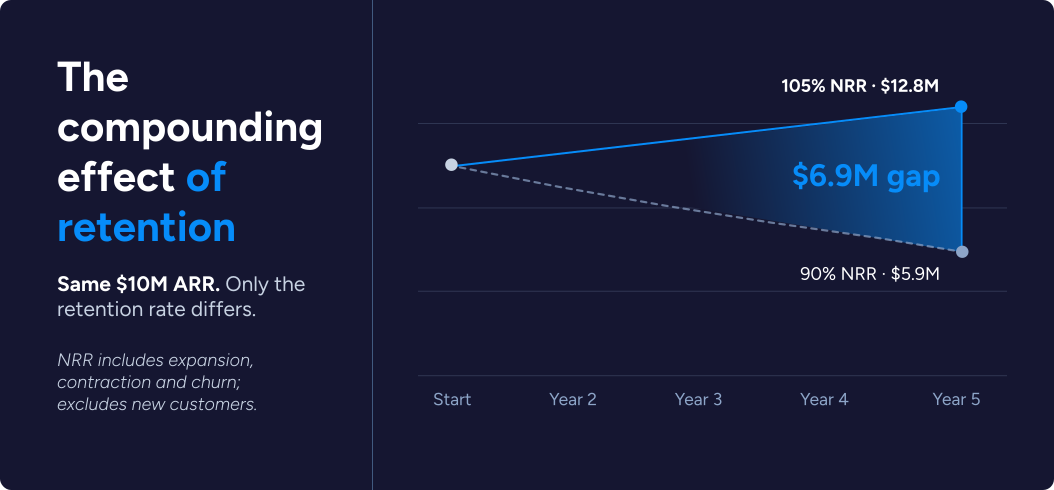
Retention shows whether customers continue to see enough value to stay.
Gross revenue retention (GRR) tells you how much recurring revenue you keep before expansion. Net revenue retention (NRR) goes a step further by accounting for expansion within the customers you already have. Together, they show whether your customer base is building on itself or whether new sales are continually replacing revenue that walked out the door.
Pricing, retention, and expansion all depend on understanding how customers get value from the product over time. That means knowing why customers stay, where they get the most value, and what puts a relationship at risk. Usage and engagement, support issues, and customer feedback can all help build that picture.
Use what you learn to shape how you retain and grow those relationships. As the product evolves and customers get more value from it, revisit pricing and packaging, and create natural ways for them to expand, whether that means adopting additional capabilities, adding users, or using the product more broadly across their organization.
It’s also worth understanding how much of your revenue depends on a small number of customers. Large customers can be valuable relationships, but if losing one would materially affect the business, you have a risk that strong overall retention may not reveal. Concentration can also make it harder to say no to an important customer when they request changes that pull your product or team away from your broader strategy.
Over time, the existing customer base should contribute more to growth. New-logo acquisition is still important, but it shouldn’t have to replace churn before it can move the company forward.
4. Build Financial Discipline and Operating Leverage
When I was building my software company, we weren’t sitting around the conference table asking about our GRR, CAC, churn, Rule of 40, or other factors that affect valuation I was focused on running the business, making payroll, serving customers, and trying to grow.
I wish I had understood sooner how much those numbers could tell me about the decisions I was making.
If customer acquisition costs are rising, look at what’s happening in your go-to-market motion. If retention is slipping, dig into the product, customer experience, and the types of customers you’re acquiring. If margins aren’t improving as you grow, understand where the business isn’t gaining the leverage you expected.
As the company grows, you should be able to answer questions like:
- How quickly are we growing, and what is driving that growth?
- How much recurring revenue are we keeping?
- What does it cost to acquire a customer, and how long does it take to earn that investment back?
- Which customer segments are most profitable and retain best?
- How are gross margin and profitability changing as we scale?
- Where are expenses growing faster than the value they produce?
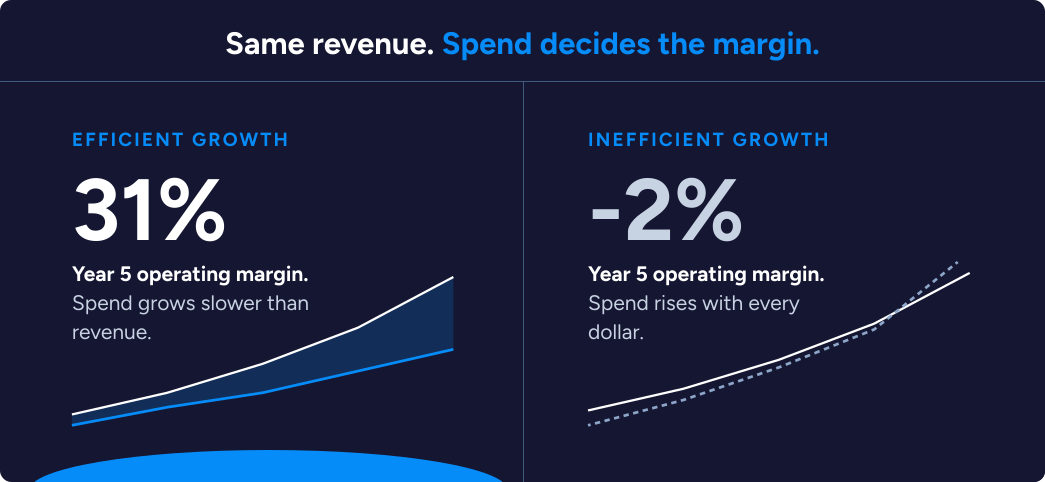
Operating leverage is part of understanding whether growth is making the business stronger. As revenue increases, you want to see whether the company can support that growth without expenses and headcount increasing at the same rate. Measures such as revenue per employee and changes in profitability can help reveal whether the business is becoming more efficient or simply getting bigger.
Growth and profitability will require tradeoffs at different stages of the company. A business may sacrifice near-term profitability to pursue a strong growth opportunity. Another may decide that additional spending is producing diminishing returns and shift toward profitability.
Either way, know what you’re getting for the money you spend.
I didn’t have a CFO asking these questions in the early days. I also didn’t have the financial maturity to question decisions that felt right to me as a founder. I held onto people longer than I should have, let customer-driven projects consume resources, and resisted raising prices because I thought customers wouldn’t accept it.
Those looked like separate operating decisions at the time, but each affected the economics of the company.
Scale should make a healthy software business stronger. Financial discipline helps you see whether that’s happening.
5. Allocate Capital Deliberately
Every dollar a software company generates or raises creates another decision.
Do you hire another salesperson? Add engineers? Invest in customer success? Enter a new market? Make an acquisition? Keep more cash on the balance sheet?
You can’t pursue every opportunity at once, and the highest-growth option isn’t always the best use of capital.
As the company grows, capital allocation needs to become more deliberate. Look at where the next dollar can produce the greatest return for the business and what has to be true for that investment to pay off.
There’s also a larger decision about how you want to finance that growth. Bootstrapping, debt, and outside equity each create a different set of tradeoffs around how much of the business you own, how much risk you carry, and how much control you have over what comes next.
- Bootstrapping allows founders to preserve ownership and control, but it can limit the pace of investment.
- Debt can preserve ownership but introduces repayment obligations and financial risk.
- Outside equity can provide capital to pursue growth more aggressively, but it comes with ownership dilution and additional stakeholders.
None of those choices is inherently better. A founder who wants to maximize growth may make a different decision from one who wants to preserve ownership. If you’re comfortable taking on more risk, you may invest more aggressively than someone who values financial flexibility.
The right answer can also change as the company, market, and your own goals change.
6. Build Predictability Into the Business
As a software company gets larger, you can’t rely on instinct and firsthand knowledge of every part of the business. You need enough visibility to understand what is driving performance and reasonably anticipate what comes next.
That starts with reliable data and consistent definitions. Sales, finance, customer success, and the rest of the leadership team should be working from the same numbers and understand how those numbers connect.
Pipeline should give you insight into future bookings. Customer behavior should help you identify retention risk. Hiring plans should reflect expected growth and capacity needs. And financial forecasts should reflect what operating teams are seeing in the business.
You want to be able to see changes early enough to respond.
If pipeline coverage deteriorates, you want to know before it becomes a bookings problem. If retention starts slipping in a customer segment, you want to investigate before the problem works its way through the financial statements.
Reliable forecasting and reporting also force you to understand why the company is performing the way it is. Instead of looking back at a good or bad quarter and explaining the result, you can identify the underlying drivers and adjust earlier.
That visibility becomes more valuable as the company grows and decisions spread across a larger leadership team. People can make better decisions when they have a common view of where the business stands and where it appears to be headed.
7. Build a Software Business That Can Scale Beyond the Founder
When you start a company, being involved in everything is an advantage. You know the product, the customers, the market, and the vision better than anyone else. You can make decisions quickly because there aren’t many layers between you and the work.
As the company grows, though, you can become a bottleneck.
Don’t fall into the founder trap of thinking: “It’s my company. I should know how to do this.” Over time, I learned that the more I knew, the more I understood how much I didn’t know and how important it was to surround myself with people who were better than I was at what they did.
At some point, your company has to be able to make good decisions when you aren’t in the room.
Give leaders real ownership and accountability, build repeatable processes, and get important knowledge out of people’s heads. Make sure key customer, product, and market relationships extend beyond the founder.
Look at where the company still depends disproportionately on you or a handful of other people:
- Are you the only person who can close the biggest deals?
- Do customers expect to call you when something goes wrong?
- Does the product roadmap stall without your input?
- Are important relationships, processes, or knowledge concentrated with a few people?
- Can leaders make significant decisions without waiting for you to weigh in?
A stronger leadership team gives the company more capacity to grow without requiring your own involvement to grow at the same rate.
It gives you more flexibility, too. You can step away for a week, change your role, pursue another opportunity, bring in outside capital, or eventually sell without putting the company’s ability to operate at risk.
Where Should You Focus First?
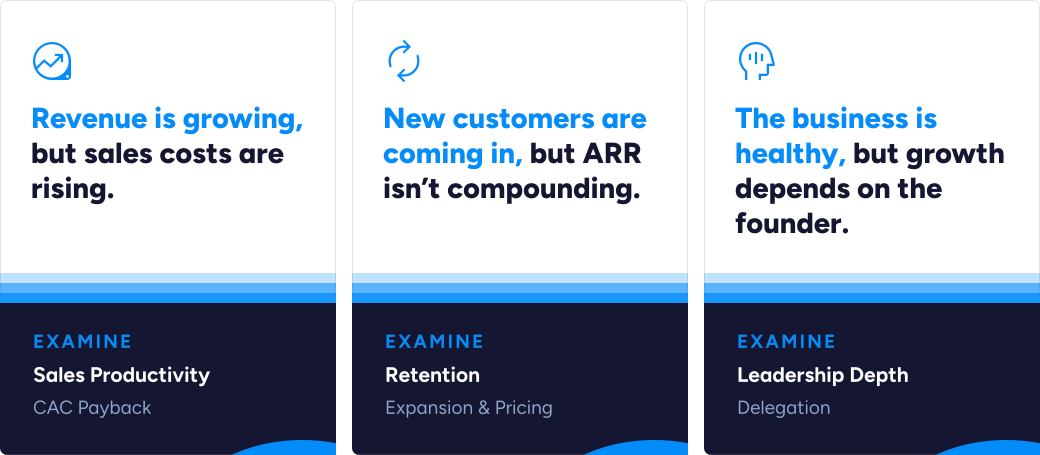
These seven areas are connected, but they won’t all need the same attention at the same time. A company with strong retention may need to improve sales productivity, while another with efficient growth may be losing too much revenue from existing customers. A third may have healthy financials but struggle to grow because too many decisions still depend on the founder.
Start by understanding what’s limiting your business today and which improvements would make the greatest difference over the next several years. You don’t need to address every weakness at once, and trying to do so may spread your people and capital across too many priorities.
Our scorecard can help you evaluate where your company stands and which areas may deserve a closer look.
Build a Business That Gives You Options
Founders don’t always know where the company will take them. You may build independently for decades or decide that outside capital can help you pursue a larger opportunity. You may want to take some money off the table, step into a different role, or eventually sell.
I didn’t know how my own path would unfold. I built BigfootCMMS into a successful software business and eventually sold it to Dude Solutions, now Brightly Software. The transaction gave me the financial freedom I had imagined years earlier.
Looking back, though, I wouldn’t tell my younger self to spend more time preparing to sell. I’d tell him to spend more time understanding what makes a business durable.
A strong market position, efficient growth, customers who stay and expand, sound economics, deliberate investment, visibility into performance, and a capable leadership team all make a software company stronger while you own it. They also put you in a better position when a new opportunity appears.
You may get that opportunity in a year, in 20 years, or not at all. Build the company so that when you decide what you want next, you have choices.