An overview of our sell-side M&A services







How AI Is Splitting the Software M&A Market in Two

The broad momentum that once lifted nearly every software company has fractured into something sharper and less forgiving.
Cheap capital is gone and so is the forgiving underwriting that allowed many deals to move forward in the past. And the idea that growth trajectory alone can justify almost any valuation? That’s gone, too.
What’s taken its place is a market that is “far more binary than it was” just a year ago, according to Stephanie Schneider, a partner with growth equity firm Five Elms, during our recent webinar on the 2026 software M&A market. Schneider was joined by Chase Thomet, a partner with JMI Equity, and Justin DuPere, partner and co-head of Waud Capital’s Software & Technology group.
One side of this market is populated with companies that combine strong fundamentals and clear, credible plans for how to compete in an AI-driven world. These businesses continue to command premium valuations and attract intense buyer competition.
On the other side is everyone else. Many of these companies may be perfectly “good.” They offer solid products, stable revenue, and high retention. But M&A outcomes are more closely tied to how clearly a business can show resilience, focus, and a credible path forward, especially with AI.
The gap between the two sides is growing.
This split is reshaping how investors evaluate companies, how founders plan for their next chapter, and what “durable value” means in an AI‑accelerated world.
Why AI Has Become the Go/No-Go Question for Buyers
For years, low interest rates and abundant capital buoyed nearly every software asset. “We kind of had a ‘rising tide lifts all boats’ backdrop… that probably pulled up the B and the C assets pretty close to the As,” DuPere said.
That tide has gone out. Valuations have reset, and underwriting is tighter. Investors are more selective. And for the first time in a decade, value compression is a real risk. Even without considering AI, the bar for deals is higher.
AI has become the real separator. It’s no longer a feature layer or a “nice to have.” Instead, it’s a core driver of valuation, competitiveness, and long‑term defensibility.
“We are asking ourselves in every opportunity in every opportunity that we evaluate, how is (this) company using AI in their product and/or how are they using it in the operations of their business? There has to be an answer for that,” Schneider said.
This isn’t a late-stage question either. It’s a go/no-go requirement.
The best companies “have great teams, they’re moving with pace on AI, and that enables them to go on offense and ultimately deliver more value to their end customers,” Thomet said.
AI is also exposing weaknesses faster. Historically, incumbents benefited from long implementation cycles, high switching costs, entrenched workflows and large feature sets that were expensive to replicate. AI erodes these advantages.
New entrants can build faster, ship faster, and deliver value faster. Incumbents that fail to modernize their product experience or data architecture risk losing the very moats that once protected them.
What Premium Tier Companies Looks Like Right Now
In the two‑speed market, A‑tier companies share a distinct set of characteristics.
Strong fundamentals. Growth, retention, and efficiency still matter, despite the market change. But they are no longer enough to earn a premium valuation on their own.
Clear product‑market fit and defensibility. The best companies have real moats: regulatory complexity, workflow ownership, proprietary data, or domain expertise. These moats are even more valuable in an AI world.
Embedded AI in both product and operations. Software companies in the premium tier must be able to “quantify revenue from AI,” Schneider said. But it has to be more than just improving efficiency or having AI as a supplementary tool. That alone will only get a company to the A‑minus category, she said.
Demonstrable outcomes, not experiments. Investors want proof, not potential, in the form of AI‑driven revenue, faster onboarding, reduced support costs, and improved NRR.
Operating with organizational velocity. AI is an operating model. The best companies move faster across engineering, support, sales and customer success.
“Every one of our LPs is asking us how we’re determining which companies we’re spending time on … and that bar has gotten higher,” DuPere said.
The new question asked by investors is simple: How does this company win in an AI‑native world? In SEG research, 80% of strategic and private equity buyers report paying a premium today for companies with AI deeply integrated into core workflows, and 87% expect that premium to increase over the next year.
This is the heart of the two‑speed market. Premium assets attract intense competition, fast processes, and strong valuations. Everyone else faces slower cycles, valuation pressure or no deal at all.
How Companies Are Closing the Gap
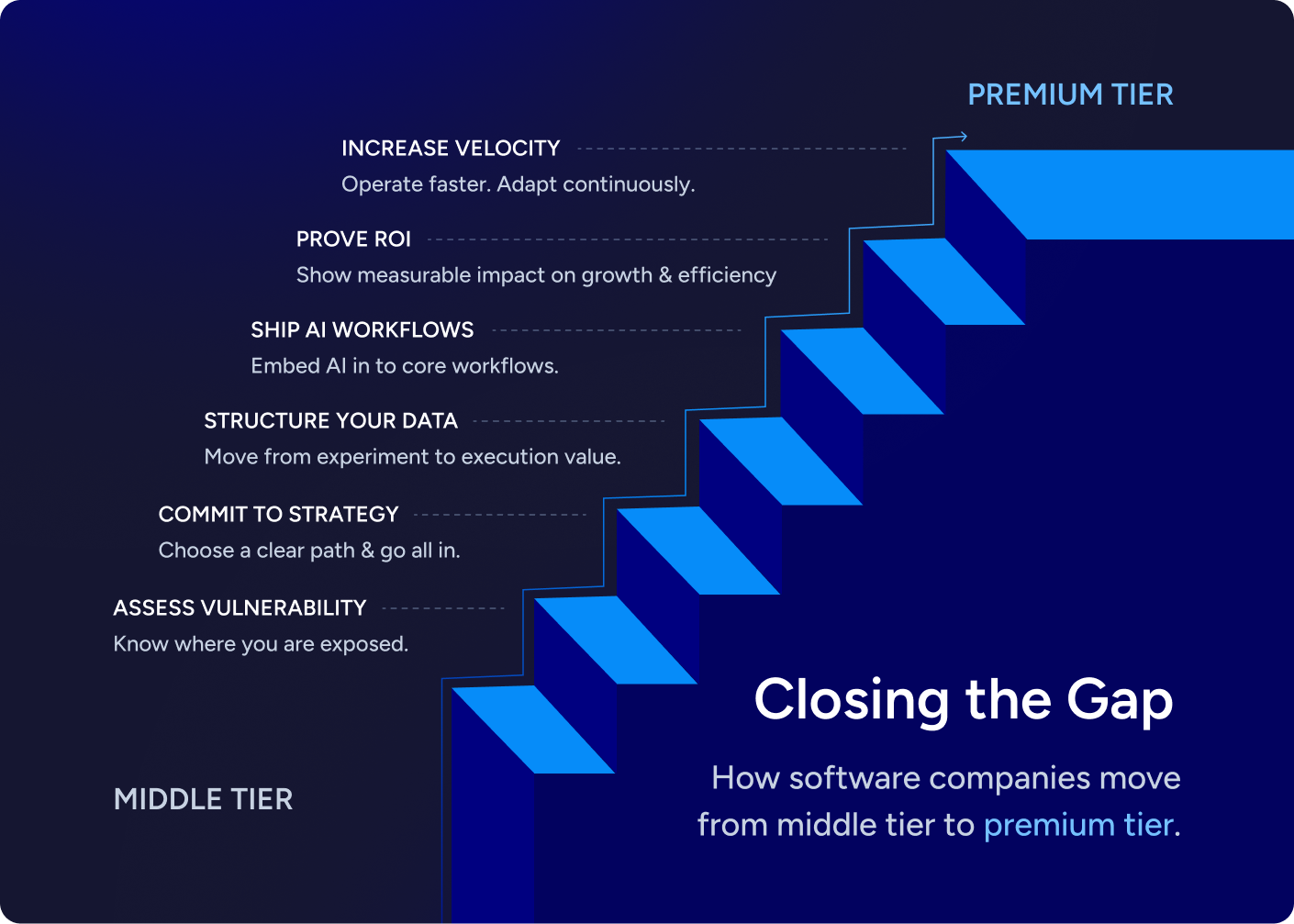
The good news is that software companies can move from the middle to the premium tier. But it requires clarity, conviction and execution. Here are some tips:
Understand where you stand. Incumbency, brand strength, and customer relationships won’t protect you from AI disruption. Assume a well-funded AI-native competitor enters your space. What protects you?
Commit to a strategy. The biggest mistake many founders make is hedging: half‑building, half‑selling. Choose whether to transform or transact.
Focus on real customer problems. AI features don’t create value; AI‑enhanced workflows do. Map where customers spend time and where friction exists.
Build a real AI roadmap. Not experiments. Not demos. A roadmap tied to measurable business impact.
Invest in data first. Data readiness is foundational, DuPere said. Companies must ensure data is structured, permissioned and secure to unlock value from AI.
Ship early, prove value. Start with one or two workflows. Demonstrate ROI. Build credibility through execution.
Increase organizational velocity. AI should touch every function, not just the product.
Leverage people and networks. No one has the full playbook. The best companies share learnings and build feedback loops.
Learn more: The AI Reset: How SaaS Founders Can Reinvent, Defend, or Exit Stronger
The software market is maturing, not collapsing. Capital is flowing. Deals are happening. Premium valuations are achievable. But the bar is higher than it’s been in at least a decade.
The market will penalize those that rely on the momentum of the past.
“Good” is no longer good enough. The companies that win will be the ones that embrace this reality early, invest with conviction, and build with the discipline and speed the modern software landscape demands.
Watch now: Expert Private Equity Perspectives on the 2026 Software M&A Market