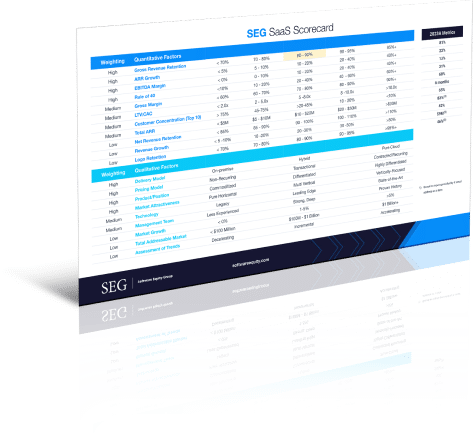
See exactly where your business is strong and where buyers will push back.

Enter your key metrics, and our scorecard maps your business across the same factors active software buyers evaluate, instantly showing you what’s working in your favor and what could cost you in a process.

SEG-Software-Company-Scorecard
Step 1 of 2

How Your Business is Built

Beyond the numbers, buyers assess how your business is positioned. These qualitative factors often set companies with premium valuations apart from those without, even when the financials look similar.

Step 2 of 2

Your Numbers

These are the quantitative metrics buyers look at first. Enter what you have; even rough figures will give you a useful picture. Nothing you enter is stored or shared.

The application, service, or solution provided and how the offering is perceived and valued in comparison to competitors.
Select
  • Commoditized
  • Differentiated
  • Highly Differentiated
How customers are charged for products and/or services.
Select
  • Non-Recurring
  • Transactional
  • Contracted Recurring
How software applications are delivered to customers.
Select
  • On-Premise
  • Hybrid
  • Pure Cloud
The potential opportunities within a market segment. Factors include size, growth rate, and competitive landscape.
Select
  • Follower
  • Challenger
  • Leader
The set of frameworks, libraries, software languages, and infrastructure of the software.
Select
  • Legacy
  • Leading Edge
  • State-of-the-Art
The group of executives leading company operations, strategies, and decision-making processes.
Select
  • Less Experienced
  • Strong, Deep
  • Proven History
The % change in the total of all companies in the market, including size, demand, and opportunities.
Select
  • <0%
  • 1-5%
  • >5%
The overall revenue opportunity available to a product or service, assuming 100% market share.
Select
  • <$100 Million
  • $100M - $1 Billion
  • $1 Billion+
(Beginning ARR – Lost ARR – Contraction ARR) / Beginning ARR
(Current Year’s ARR – Previous Year’s ARR) / Previous Year’s ARR. Note: One-time payments are not included.
(Net Income + Interest + Taxes + Depreciation + Amortization) / Total Revenue
Rule of 40
(Revenue – COGS) / Revenue
ARR per Employee
LTV:CAC
Select
  • 2.0x
  • 2-5.0x
  • 5-8.0x
  • >8-10.0x
  • >10.0x
Payback Period
Select
  • 24 Months
  • 19-24 Months
  • 13-18 Months
  • 7-12 Months
  • <7 Months
Sum of ARR of Top 10 Customers / Total ARR
The yearly revenue from software subscriptions, often called the annualized version of monthly recurring revenue (MRR).
(Beginning ARR + Expansion ARR – Lost ARR – Contraction ARR) / Beginning ARR. Also called Net Dollar Retention.
(Current Year Total Revenue – Prior Year Total Revenue) / Prior Year Total Revenue. Unlike ARR growth, Revenue Growth aggregates all revenue sources.
(Total Customers at beginning of period – Lost Customers in that period) / Total Customers at beginning of period.
THE RESULTS

Here’s Where You Stand. 

Green areas work in your favor; these are the factors buyers respond well to. Amber and red areas are where buyers will push back, ask harder questions, or use to justify a lower offer. The further left a factor sits, the more urgently it should be addressed before any conversation begins.

Seeing amber or red?

Not finding your results in the green?

There’s a reason and usually a path forward. Most companies have 2 to 3 areas that buyers use to justify a lower offer. Understanding why each factor matters and what moves the needle is the difference between going into a process prepared and going in blind.

Not finding your results in the green?
Your SaaS Scorecard
Weighting
Qualitative Factors
Lower Multiples
Higher Multiples
High
Production/Position
Commoditized
Differentiated
Highly Differentiated
High
Pricing Model
Non-Recurring
Transactional
Contracted Recurring
High
Delivery Model
On-Premise
Hybrid
Pure Cloud
High
Competitive Positioning
Follower
Challenger
Leader
Medium
Technology
Legacy
Leading Edge
State-of-the-Art
Medium
Management Team
Less Experienced
Strong, Deep
Proven History
Low
Market Growth
<0%
1-5%
>5%
Low
Total Addressable Market
<$100 Million
$100M - $1 Billion
$1 Billion+
Low
Assessment of Trends
Decelerating
Incremental
Accelerating
Weighting
Quantitative Factors
Lower Multiples
Higher Multiples
High
Gross Revenue Retention
< 70%
70 - 80%
80 - 90%
90 - 95%
95%+
High
ARR Growth
< 5%
5 - 10%
10 - 20%
20 - 40%
40%+
High
EBITDA Margin
< 0%
0 - 10%
10 - 20%
20 - 40%
40%+
High
Rule of 40
< 10%
10 - 20%
20 - 40%
40 - 60%
60%+
Medium
Gross Margin
< 60%
60 - 70%
70 - 80%
80 - 90%
90%+
Medium
ARR Per Employee
< $100K
$100K - $175K
$175K - $250K
$250K - $325K
> $325K
Medium
LTV:CAC
2.0x
2-5.0x
5-8.0x
>8-10.0x
>10.0x
Medium
Payback Period
24 Months
19-24 Months
13-18 Months
7-12 Months
<7 Months
Medium
Customer Concentration (Top 10)
> 75%
45 - 75%
>20 - 45%
10 - 20%
<10%
Medium
Total ARR
< $5m
$5 - $10M
$10 - $20M
$20 - $30M
>$30M
Low
Net Revenue Retention
< 85%
85 - 90%
90 - 100%
100 - 110%
>110%
Low
Revenue Growth
< 5-10%
10 - 20%
20 - 30%
30 -50%
>50%
Low
Logo Retention
< 70%
70 - 80%
80 - 90%
90 - 95%
>95%+
202? Metrics
0%
0%
0%
0%
0%
0%
0
0
0%
$0M
0%
0%
0%

1) Based on inputs provided on April 19, 2026.

Before You Go

Please be sure to screenshot your scorecard results, as we are not storing this information due to your privacy.