The AI Reset: How SaaS Founders Can Reinvent, Defend, or Exit Stronger

pillar-banner-arrow
TABLE OF CONTENTS
    Shadow-break-left

    Every software era has a moment when the rules change faster than the players expect. This is that moment.

    Artificial Intelligence is the most exciting and consequential development the software industry has seen in more than a decade. It represents a dramatic expansion in what software can do, not just store data or manage workflows, but reason across information, surface insight, automate decisions, and take action. AI is pushing software beyond access and into intelligence.

    The cloud SaaS era transformed distribution, economics, and scalability. It digitized industries, centralized data, and created durable, recurring revenue models. AI builds on that foundation. It does not erase it. Instead, it introduces a new layer of capability; one that reduces cognitive overhead, increases operational efficiency, and embeds intelligence directly into the workflows customers already depend on.

    This shift will create pressure. AI-first entrants can move quickly, experiment aggressively, and challenge established feature sets. At the same time, existing SaaS platforms offer significant advantages: trusted customer relationships, mission-critical workflow control, and rich first-party data generated within their systems. In many vertical markets, those assets are powerful starting points for intelligent evolution.

    The opportunity in this reset is not simply to “add AI.” It is to determine how intelligence compounds within your existing architecture, workflows, and customer base. For some companies, that will mean reinvention. For others, it will mean selective enhancement. But across the market, the companies that thoughtfully integrate AI into the core of how value is delivered, rather than treating it as a surface feature, will define the next phase of competitive leadership. Buyer expectations, valuation frameworks, and competitive dynamics continue to evolve as AI adoption accelerates across software markets.

    Phases-of-SaaS-AI-Evolution2

    overlay-color
    image-arrow
    TABLE OF CONTENTS
      INTERACTIVE TOOL

      Want Is Your
      Company Worth?

      Begin Assessment

      What We Mean by AI

      Artificial Intelligence is not a single technology or feature. It is a broad set of capabilities that allow software to observe data, recognize patterns, reason across context, generate outputs, and recommend or act. In practice, AI includes multiple techniques, such as:

      • Generative AI and Large Language Models (LLMs) for content, copilots, and conversational interfaces
      • Predictive and prescriptive analytics for forecasting, optimization, and decision support
      • Natural Language Processing (NLP) and speech technologies
      • Computer vision for interpreting images and video
      • Anomaly detection and pattern recognition for risk, compliance, and monitoring
      • Agentic systems that coordinate tasks and actions across workflows

      These capabilities are increasingly combined and embedded directly into products and operations, rather than delivered as standalone tools.

      SEG surveyed private equity and strategic buyers on how they expect AI to reshape the SaaS landscape. Only 20% believe traditional SaaS companies will adapt primarily by leveraging existing data, scale, and distribution advantages. The majority expect AI to play a more structural role:
      SaaS-Buyers-of-AI-hybrid-companies

      Throughout this report, AI is evaluated not as a novelty or feature, but as operating leverage: intelligence applied to real workflows that improves outcomes, reduces friction, strengthens retention, and increases scalability and defensibility.

      Shadow-break-right

      Why the AI Reset is Different

      Every platform transition reshapes software markets, but not every reset behaves the same way. Based on what we’re seeing, this one is operating under different dynamics.

      This reset is moving faster. Previous platform shifts took years to influence valuations. AI adoption cycles are measured in quarters, not years. Buyers are adjusting valuations in real time and redefining what qualifies as an attractive target based on early execution. We’re already seeing an impact. Eighty percent of respondents to SEG’s buyer survey reported a slight or significant uplift in valuations for companies that are AI-native or have significant integration of AI in core workflows today; 87% expect a premium for the same companies a year from now. In practice, valuation frameworks are adjusting faster than prior platform shifts, with buyer expectations often resetting ahead of visible changes in financial performance.

      The risk of substitute products is higher than ever. In the SEG survey, private equity and strategic buyers said the biggest risk AI poses to SaaS companies’ success and valuation is the risk of commoditization/loss of differentiation. This is because AI has compressed the time, cost, and expertise required to build software, allowing small teams, and, in some cases, individual domain experts, to use generative models, agents, and AI-assisted development to create credible, competitive products in weeks, not months. As a result, markets that once supported only a handful of dominant vendors are now seeing dozens of viable challengers. As AI lowers development costs and accelerates product replication, buyers are increasingly discounting feature-based differentiation in favor of data depth, workflow control, and system-level intelligence.

      The shift is already being felt: 64% of SaaS CEOs in an SEG survey said they believe generative AI is already lowering barriers to entry in their markets, and another 20% expect to see that impact within the next one to two years.

      AI is being built into the fabric of software. Unlike past shifts that required adopting new devices or re-platforming entire systems, AI integrates directly into the layers companies already use: data pipelines, workflows, decisioning, and customer interactions. Because AI enhances existing processes rather than replacing them, adoption accelerates without forcing users to change behavior.

      For SaaS companies between $5 million and $50 million ARR, the implications of this reset are immediate. You’re big enough for strategic acquirers and private equity buyers to take seriously and small enough that focus, architecture, and team decisions today will determine whether you scale into category leadership or face consolidation pressure.

      SEG has guided hundreds of founders through every major industry shift, from early client-server days to mobile to cloud-native SaaS. We’ve seen how quickly options can narrow during platform transitions. What looks like a $200 million outcome today can quickly shrink if momentum fades or the market’s focus shifts elsewhere.

      Shadow-break-right

      The Founders' Dilemma

      Most SaaS founders understand that AI will reshape their industry. The harder question is what to do about it now, with limited time, capital, and capacity. The dilemma is not whether AI matters, but how aggressively to act, where to invest, and which risks to accept as customer expectations, competitive dynamics, and buyer criteria shift. AI is now broadly viewed as foundational to future competitiveness across SaaS. The strategic question is no longer whether AI matters, but how effectively it is operationalized within products and operations.

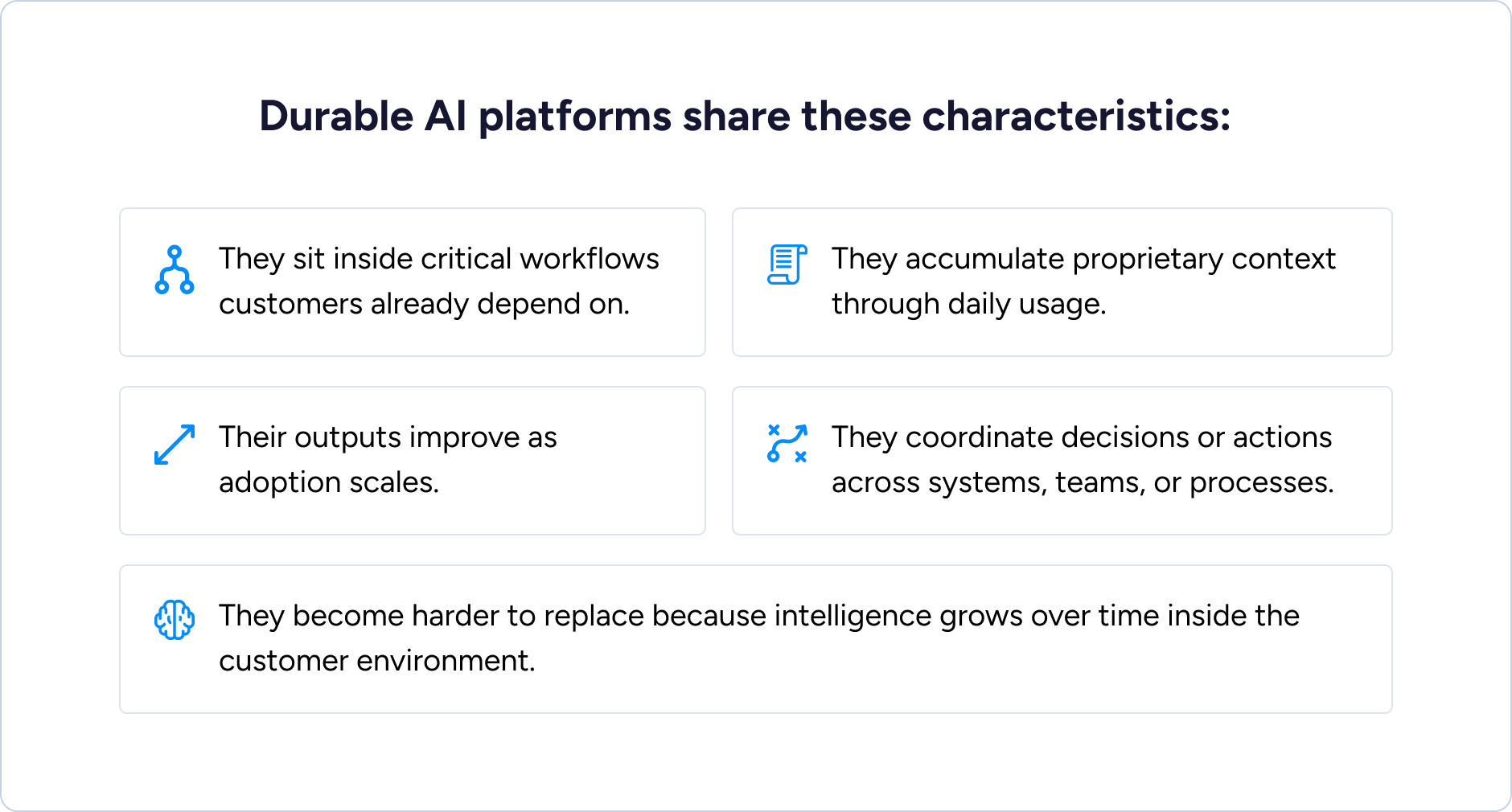
      It is important to note that in this reset, AI is not the product. Value is created when AI improves the underlying product, and when the organization behind that product uses AI to strengthen workflows, operating processes, and decision-making. Simply “having AI” means nothing to buyers or users. Buyers are also underwriting whether a company’s data, workflows, and operating discipline allow intelligence to compound over time. That distinction separates durable platforms from replaceable tools.

      Founders face a choice: Reinvent the product and operating model to capture AI leverage, selectively enhance the business to improve retention and efficiency, or position the company for an exit before the market fully resets. Each path involves tradeoffs, and waiting too long can limit the outcomes available.

      1. Reinvent: Modernize core workflows, product, and architecture for AI leverage.
        This path is for founders ready to treat AI as an operating-model shift, not a feature. Reinvention means rebuilding the parts of the business that create scale: data architecture, core workflows, product roadmap, and internal processes. To do this, SaaS leaders need to invest in infrastructure, talent, and reducing technical debt.
      2. Enhance: Embed AI into operations and customer experience to increase customer retention and valuation multiples.
        Enhancement is about improving what exists without overhauling the foundation. For many companies, enhancement is about making existing systems more participatory: reducing friction, surfacing insight earlier, and lowering the cost to serve without changing the core product. This includes embedding AI into support flows, customer onboarding, documentation, forecasting, sales productivity, or renewal management. These are areas where AI measurably improves Gross Revenue Retention, Net Revenue Retention, and margins.
      3. Exit: Sell into the premium window before competitive dynamics erode value.
        As AI lowers the cost of building credible alternatives, buyers are sensitive to products that can be replicated faster than they can compound value. Exiting now lets founders capitalize on increased buyer appetite, especially if their product, data, or vertical positioning give a buyer a path to scale with AI.

      At $5M–$50M ARR, every AI decision is a capital allocation decision, one that determines whether your product becomes more indispensable or more replaceable. These decisions are being made while teams are stretched thin. Most SaaS leaders in this range are battling talent shortages, tech debt from the last growth cycle, and customers who aren’t adopting AI as fast as the market narrative suggests. The challenge is capacity.

      There are tradeoffs with each decision:

      • Reinvention means deprioritizing something else.
      • Enhancement requires immediate ROI.
      • And exit means timing the market while value still exists.

      Before founders choose a path, it’s worth remembering: This isn’t the first platform reset to redraw the winners. History shows exactly how these moments play out. At this stage, the window for optionality shrinks quickly as competitors close the gap and buyers concentrate their attention on companies with a clearer path to AI-driven scale.

      “You don’t control the market. This adoption cycle magnifies market forces, compressing timelines and reducing the margin for hesitation.” – Paul Lachance

      Shadow-break-right

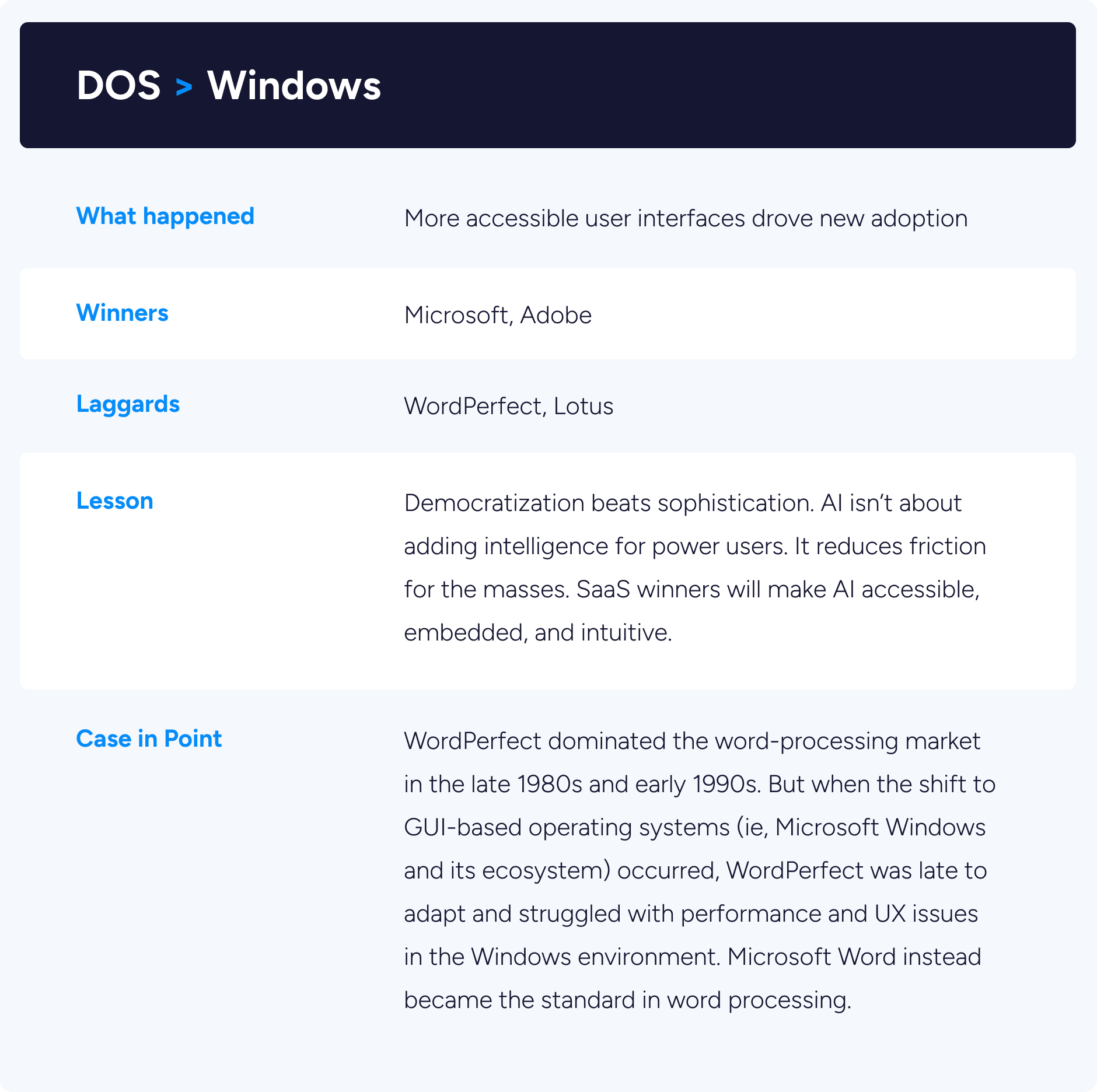
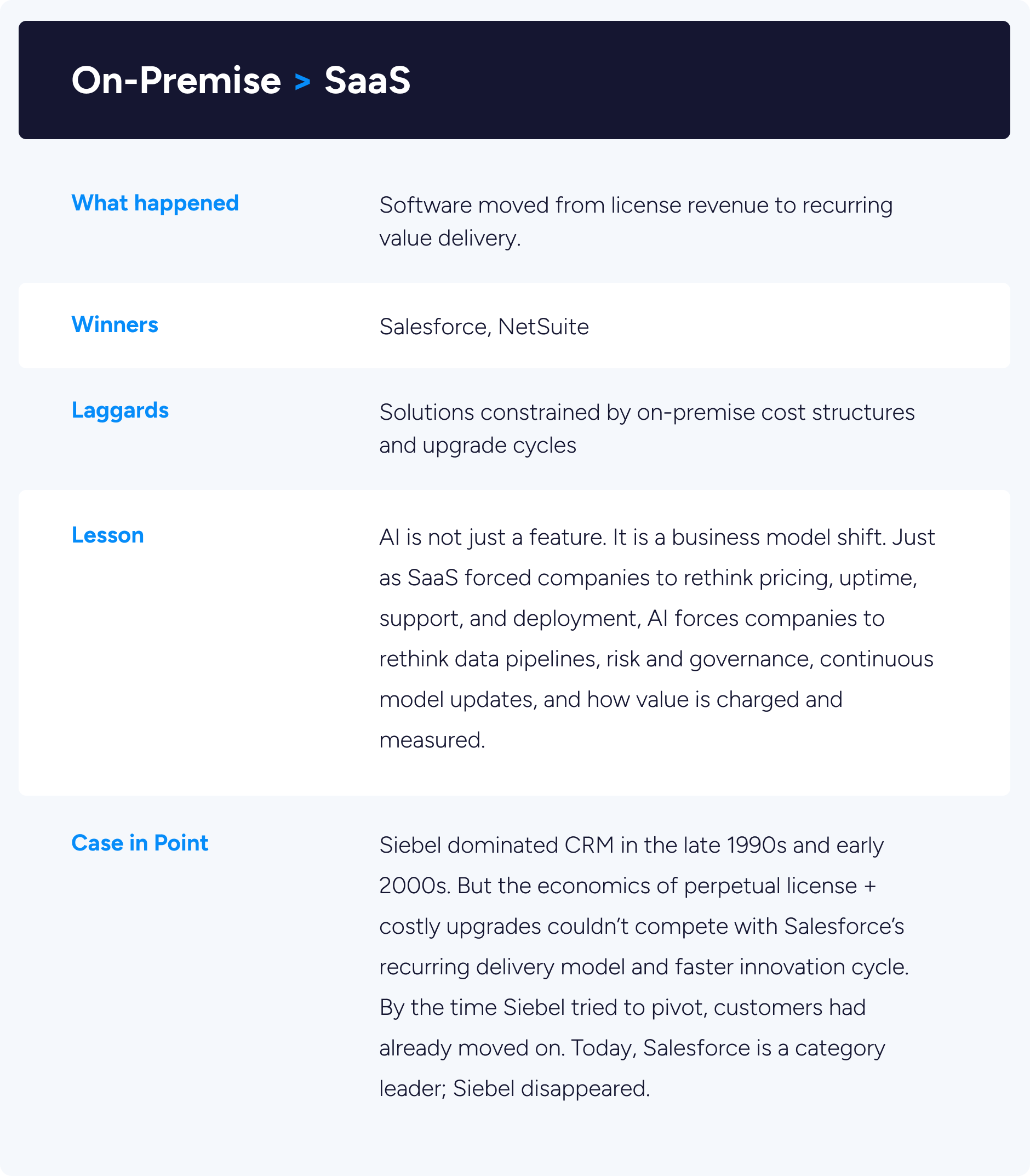
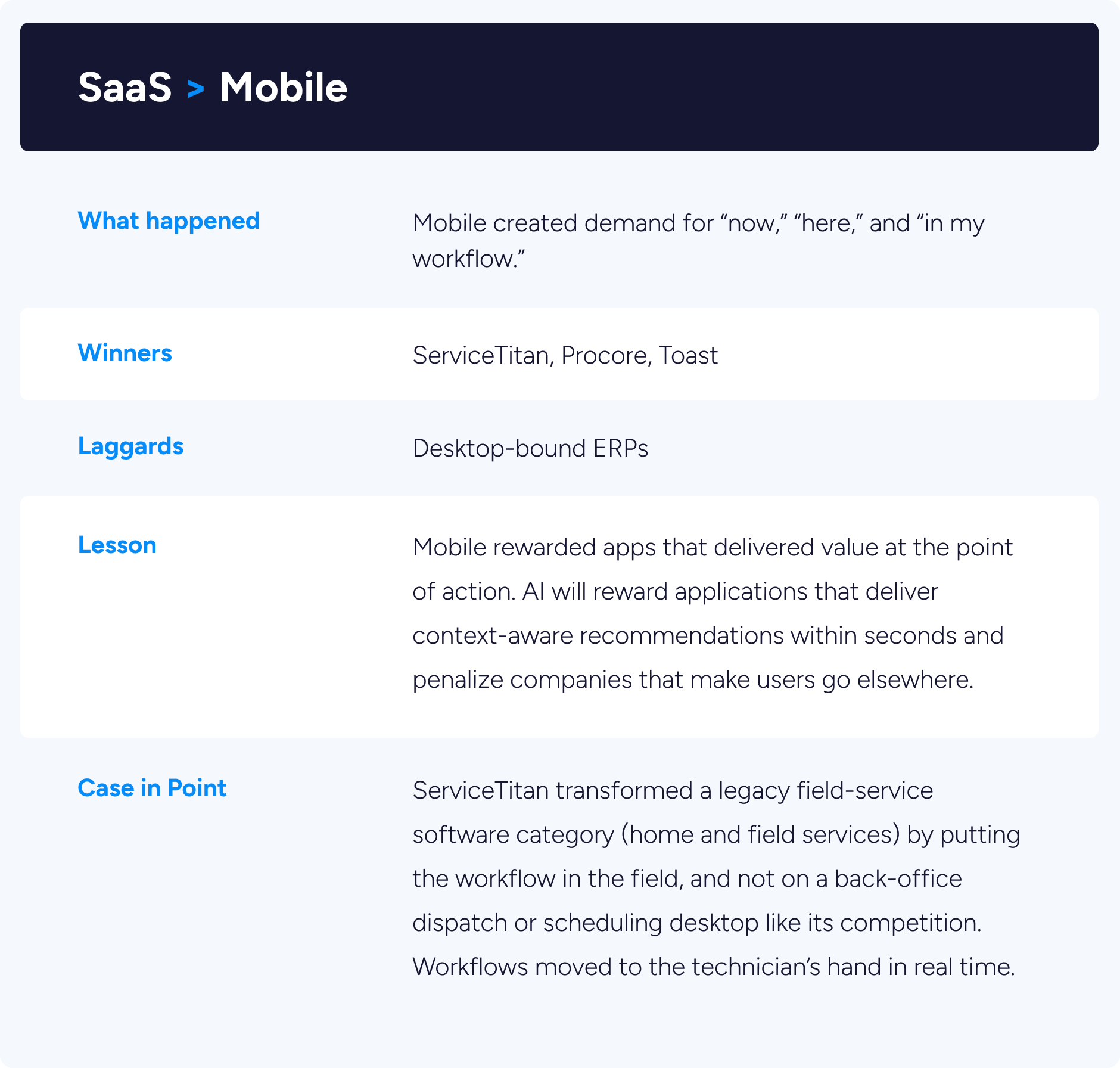
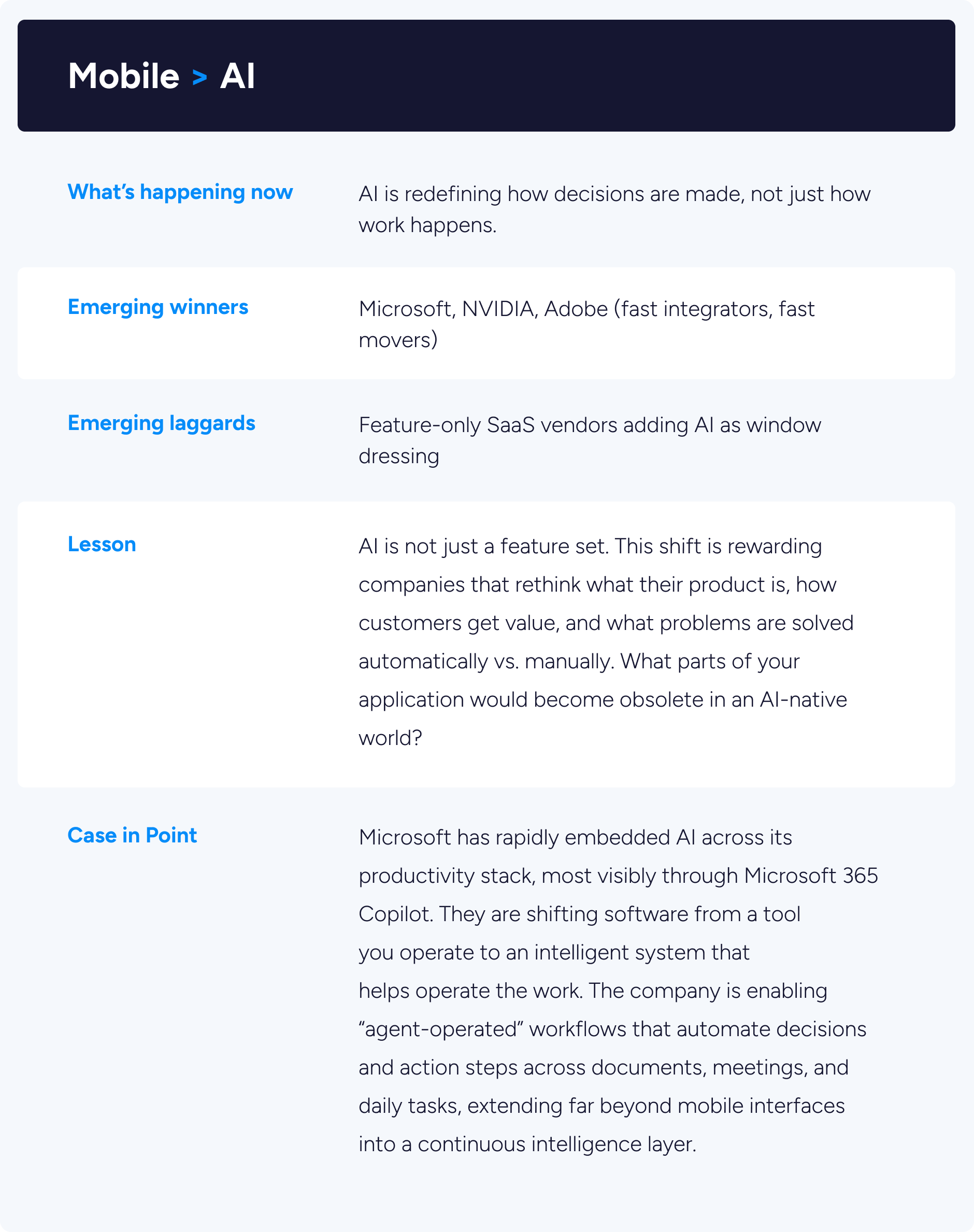
      Lessons from Past Technological Resets

      Every major technology reset has followed the same pattern:

      It rewards companies that evolve their products and business models, and punishes those who confuse incremental features with true reinvention.

      DOS-Windows-AI-Case-In-Point1

      On-Premise-SaaS-AI-Case-In-Point

      SaaS-Mobile-AI-Case-In-Point

      Mobile-AI-Case-In-Point

      Each of these resets rewarded companies that adapted their architecture, data model, and user experience early. Yet across the $5M–$50M ARR market, many teams are still in pilot mode with AI.

      Shadow-break-right

      The Great AI Execution Gap: Everyone Believes, But Few Are Ready

      Every major technology shift rewards early execution, not late conviction. AI is no different. While belief in AI’s importance is now nearly universal among SaaS leaders, readiness to act on that belief is more uneven.

      In our survey, roughly two-thirds of SaaS CEOs said embedding AI into their product is essential to future competitiveness. Eighty-two percent of buyers have already seen a premium in the market for companies that are AI-native or have significant integration of AI in core workflows. On the surface, alignment between buyers and SaaS leaders looks strong. While many companies report active AI initiatives, buyer diligence increasingly reveals wide variation between experimentation and production-grade, workflow-embedded execution.

      But leaders’ confidence frays under closer inspection.

      More than half of CEOs said AI-native startups do not represent a serious competitive threat, citing incumbency, brand strength, and customer relationships as buffers against AI-first challengers. The assumption: Speed matters, but scale and trust will matter more. Incumbent confidence is increasingly conditional. Buyer underwriting now focuses less on legacy position and more on a company’s ability to adapt its data architecture, workflows, and operating model at speed.

      Nearly two-thirds of buyers told SEG they see only limited AI adoption in the companies they’re currently evaluating. At the same time, 61% expect future targets to be meaningfully AI-driven in a year, with core differentiation or go-to-market strategies built around AI capabilities. The direction of travel is clear, even if SaaS companies’ execution has not yet caught up.Buyer-AI-Prediction-StatsThis gap is most evident in how risk is perceived. While 80% of buyers worry that AI will accelerate commoditization, only a quarter of CEOs cite it as AI’s biggest threat. Most leadership teams are prioritizing operational AI, sales efficiency, marketing automation, customer success, and data governance, while product-level AI differentiation remains a secondary focus. While many companies prioritize near-term operational ROI, buyers are placing growing emphasis on data infrastructure and system-wide intelligence as prerequisites for durable AI leverage. One commonly cited constraint among CEOs: 41% cite a lack of technical talent.
      80-percent-AI-Commoditization-Top-RiskAnother is conviction at the execution level. Seventeen percent say they still don’t see a clear ROI or business case for AI, making it harder to justify deeper product investment even as buyers move ahead with those assumptions baked into valuation and diligence. That means many founders may not understand the potential applications of AI to make customers’ lives easier and their own operations more efficient.

      The result is uneven acceleration.

      AI doesn’t lift all companies equally. AI-native competitors start with clean data, modular architectures, and workflows designed around intelligence from day one, allowing speed to compound quickly. Established SaaS companies must retrofit AI into legacy systems, address technical debt, and honor long-standing contractual commitments. Belief may be universal, but readiness is not.

      That gap has consequences. As AI lowers barriers to entry, the risk of substitution rises. Buyers won’t wait for incumbents to catch up. In a market where intelligence compounds, execution will determine who owns the future.

      “AI claims without measurable results don’t create upside. They create skepticism, and skepticism shows up in valuation.” – Paul Lachance

      Shadow-break-right

      What Strategic Buyers and Financial Sponsors Are Looking For

      From AI feature > business leverage 

      Because AI is now evaluated as an operating capability, buyers discount isolated features and reward system-wide leverage that shows up in margins, retention, and scale. SaaS companies that can tie AI to revenue growth, cost reduction, or customer expansion will command a premium valuation. Importantly, buyers also evaluate how AI is used inside the business. High-leverage internal applications such as automated support workflows or coding support show that a SaaS company is positioned to adapt and scale.

      These internal gains translate directly into valuation by reducing risk and strengthening confidence in future cash flows. Stronger Gross Revenue Retention (GRR) and Net Revenue Retention (NRR) signal revenue durability, while higher-quality product releases, improved support, and stronger sales and marketing productivity improve margins, scalability, and competitive positioning.

      From one-off tools > system-wide intelligence  

      Disconnected tools create more noise than value. Buyers and investors prioritize AI that flows through product, customer experience, and operations. System-wide intelligence signals scalability and defensibility, traits buyers consistently reward.

      From experimentation > fluency 

      Buyers want teams that understand AI’s implications across their business, can quantify value, and have built internal confidence around responsible deployment. Fluency builds credibility, and credibility drives valuation.

      From growth at all costs > AI-driven efficiency  

      Growth is not enough. Buyers want to see AI contributing to efficiency and not just innovation. Companies that show how automation, predictive analytics, or AI-augmented workflows improve profitability are aligning with where capital is moving.

      Shadow-break-right

      Where AI is Creating Value

      These early examples show what AI looks like when it drives real outcomes.

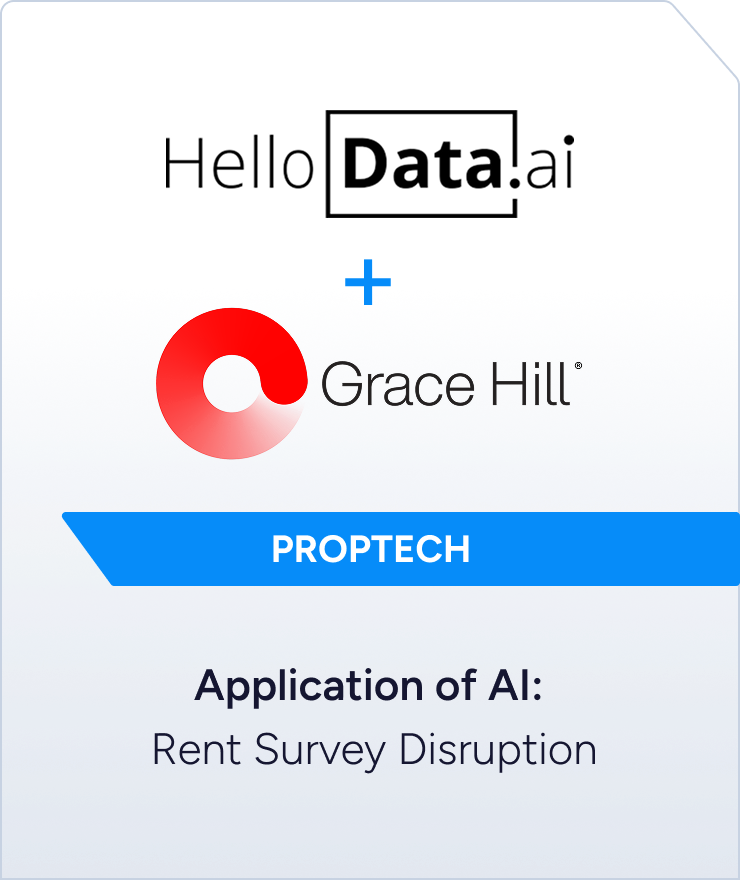
      HelloData-Application-of-AI

      HelloData AI automates multifamily rent and market analysis by embedding intelligence directly into the workflows managers already use. The platform continuously ingests, structures, and normalizes millions of fragmented property-level data points across more than 35 million units nationwide. It uses AI to identify patterns, infer market conditions, and surface real-time insights on rents, concessions, amenities, and competitive positioning. Their strength was not just the modeling capability, but the data engine behind it: a continuously improving, workflow-connected dataset where AI accuracy and relevance compound with use.

      Grace Hill acquired HelloData because that data advantage could be applied across its broader portfolio, extending intelligence beyond a point solution and strengthening its position as a system of action for multifamily operators.

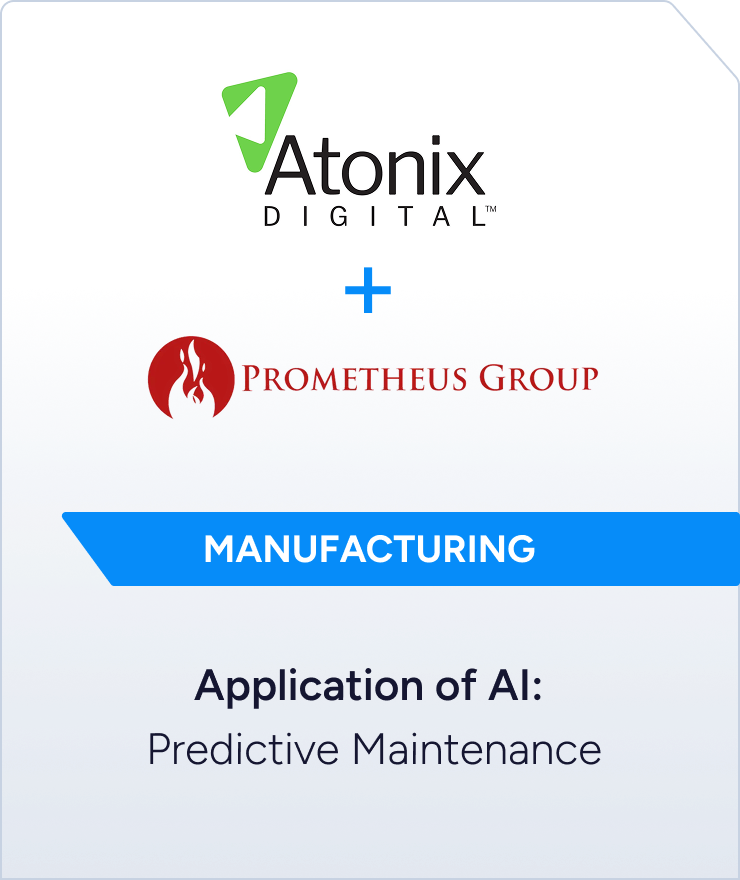
      Atonix-Digital-AI-ApplicationAtonixOI applied predictive analytics to large volumes of operational data from physical assets, enabling early detection of shifts in equipment behavior that signal impending failure. AtonixOI helped operators move from reactive to predictive, reducing downtime and operational risk. Following the acquisition, Prometheus Group integrated AtonixOI into its AI-driven asset performance management platform, extending these capabilities to provide context, diagnostics, and recommended actions based on models trained on decades of real-world data.

      Beyond these deals, we’ve seen powerful applications of AI in:

      Government: AI automates and coordinates civic operations by reasoning across procurement, case management, dispatch, GIS, and regulatory data. Applications help caseworkers make eligibility decisions, flag compliance risks, prioritize backlogs, and deliver faster, more consistent public services with limited staff.

      Education: AI identifies at-risk students and operational bottlenecks by analyzing LMS activity, student information systems, assessments, attendance, advising notes, and engagement data. It recommends targeted interventions, alert advisors, optimize course pathways, and support retention efforts.

      Healthcare: AI coordinates insight across EHRs, device telemetry, lab systems, staffing schedules, and bed management tools to surface risk signals, guide care-team prioritization, and support clinical and operational decision-making when capacity is chronically constrained.

      Across all these examples, the pattern is the same: AI systems that don’t just assist workflows but take on defined responsibilities, scaling expertise where teams are already stretched thin.

      Shadow-break-right

      Questions That Should Define Founders Next 18 Months

      The future isn’t binary: leader or laggard. Most SaaS companies are in the middle of the journey. What matters more is direction and momentum – not being AI-native. It’s about how quickly you can build the foundations that make AI valuable and defensible.

      There’s no single correct response. Choose a path that aligns with your reality: your team, capital, market position, and tolerance for risk. The following questions are designed to help you start the conversation.

      1. Do you have the capacity to operationalize AI, and not just explore it?

        AI experimentation is now table stakes. Execution is not. Moving from pilots to production requires sustained ownership, product discipline, and operational follow-through. This includes building AI into core workflows, supporting it in production, and continuously improving it as usage scales. Clean, connected data and modern workflows determine whether those outcomes are consistent or whether AI remains a demo.Reinvention makes sense when:

        • You can commit dedicated teams to AI-driven product development
        • You’re prepared to simplify or deprioritize other initiatives to move faster
        • You believe AI can materially change how customers experience your product, not just enhance it

        Without that commitment, reinvention often consumes time and capital while leaving buyer perception unchanged.

      1. Can AI reliably improve outcomes for customers and the business?

        AI creates value in two ways for SaaS companies: by improving the product experience for customers and by improving how efficiently the business operates.For many companies, the most practical gains come from selective enhancement: using AI to reduce friction, improve retention, lower support costs, or increase sales efficiency within existing workflows.This path tends to work when:

        • AI improvements show up in metrics buyers already underwrite
        • Gains are repeatable and scalable, not dependent on heavy customization
        • Internal use of AI materially improves margins or operating leverage

        Enhancement strengthens durability, even if it doesn’t redefine the category.

      1. Does reinvestment expand your upside or increase your risk?

        The AI reset is expanding opportunity for some companies and compressing it for others. Timing plays a critical role in determining which side you fall on. AI is increasingly influencing not just valuation, but the timing of strategic decisions, as prolonged uncertainty can introduce greater risk than decisive action. Reinvestment makes sense when you have a clear path to differentiation. It’s riskier when competition is multiplying faster than your ability to adapt. An exit may be the right strategic choice when:

        • Market expectations are shifting faster than your roadmap
        • Buyer questions are becoming harder to answer
        • Additional time is more likely to introduce uncertainty than upside

        Selling before the market fully resets can preserve value rather than sacrifice it. Nearly 40% of CEOs in our survey say they are considering accelerating an exit, while another 18% are delaying a sale until the impact of AI adoption becomes clearer. The remainder report that AI has not materially influenced their exit planning.

      AI-Impact-on-Exit-Timing

      Shadow-break-right

      Founders Choices are to Reinvent, Enhance, or Exit

      If you made no material changes over the next 18 months, would your business be more valuable or less? 

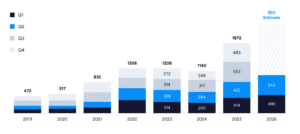
      AI is reshaping how SaaS companies are valued, bought, and backed. ERP, DevOps, and Security platforms, where AI has clear impact, are leading valuation medians in Software Equity Group’s 2026 Annual SaaS Report. These categories consistently land in the 6.3x-6.9x EV/TTM Revenue range, compared to the broader Index median of 4.8x. In addition, AI-referenced deals comprised 72% of all SaaS transactions in 2025, a 12x increase since 2018, reflecting how quickly AI has become a target focus for buyers & investors.

      The window for premium outcomes will narrow faster in this shift than any before it. Expectations are moving in quarters, not years, and buyers are pricing readiness in real time.

      In this reset, feature-led AI narratives no longer create upside unless they change how work gets done for customers or inside the business. They compress valuation when not tied to operating leverage.

      Most SaaS leaders believe AI will increase their competitiveness and enterprise value. AI has raised valuation expectations across the market; however, buyers are increasingly separating AI narratives from demonstrated operating leverage and defensibility. Yet only a small fraction can demonstrate that impact today. That gap is where opportunity lives. Buyers want proof. Instead of feature lists and announcements, they’re looking at what really drives durable growth. Measurable outcomes matter. Unified data and credible execution matter.

      This is the fastest, deepest platform shift the SaaS industry has experienced.

      What will you do?

      • Reinvent the product to deliver new intelligence and new reasons to buy
      • Enhance the existing foundation with embedded AI that expands margins and deepens customer commitment
      • Exit while premiums exist, possibly with a partner who brings capital and capability to accelerate the transition

      The timeline matters. The strong are getting stronger, and the slower face rising substitution risk and recurring revenue under question. In fact, SaaS companies in our survey recognized these risks, citing valuation pressure and higher buyer expectations, commoditization, and the rising cost of talent.

      This is not a hype cycle. It is a valuation cycle. Readiness is differentiation. SEG has helped founders through every major software transformation, from on-prem to SaaS to mobile and now AI. We’ve seen how readiness creates leverage in an M&A process. We’ve also seen what happens when great companies wait too long.

      Will you be among the next generation of category leaders? Reinvent. Enhance. Or exit with an advantage. But act now before the choice disappears.

      AI-Driven-SaaS-M&A-Deal-Volume1

      Shadow-break-right

      About the AI in SaaS Survey

      We surveyed approximately 450 SaaS CEOs and founders, as well as private equity and strategic buyers, in our inaugural AI in SaaS survey in the fourth quarter of 2025. SaaS operator respondents were evenly distributed across revenue ranges from under $5M to $100M ARR. The survey explored how SaaS CEOs view, adopt, and plan around AI, as well as how buyers view AI’s impact on the market.

      Shadow-break-right

      Disclaimer

      The information contained in this Report is obtained from sources that SEG Capital Advisors LLC (“SEG”) believes to be reliable. However, SEG makes no representations or warranties, express or implied, about the accuracy, completeness or fairness of such information, or the opinions expressed herein. Nothing in this Report is intended to be a recommendation of a specific security or company or intended to constitute an offer to buy or sell, or the solicitation of an offer to buy or sell, any security. Any person or entity reviewing this report (a) should conduct its own diligence and reach its own conclusions regarding its business transactions, (b) should not rely upon any conclusions reached by SEG, and (c) should consult its own advisors regarding its tax, accounting, financial, and/or business decisions. SEG or its affiliates may have an interest in one or more of the securities or companies discussed herein.

      This Report may not be reproduced in whole or in part without the expressed prior written authorization of SEG or one of its affiliates