An overview of our sell-side M&A services







How to Select the Right Buyer for Your Software Company

Founders spend years building something worth acquiring. When it comes time to sell, the natural instinct is to focus on who will pay the most. That instinct is understandable, but it tends to crowd out the questions that shape what happens after the deal closes.
The buyer you choose determines more than the purchase price. It influences how your team experiences the transition, how your product evolves, what your own role looks like in the months and years that follow, and whether the outcome you imagined materializes. Two offers at the same headline valuation can produce very different results depending on structure, intent, and fit.
Most founders do not realize they have more control over this decision than they think. The process of selecting a buyer is not just about evaluating offers. It is about understanding what you are optimizing for and finding the buyer whose thesis, approach, and post-close behavior aligns with that.
Start With Your Own Goals, Not the Offers
Before evaluating any buyer, founders benefit from getting clear on what a successful outcome looks like for them. That clarity rarely comes from the offers themselves.
Some founders want a full exit and a clean transition. Others want to stay involved in leading the business through its next phase of growth. Many care deeply about what happens to their team and the culture they built. Some want to retain equity and participate in future upside. Most want some combination of these things, weighted differently depending on where they are in their lives and what they built.
Mark and Laurie Smith, founders of Core Sound Imaging, described this directly when reflecting on their process. The offer they ultimately chose had components that mattered to them beyond valuation. Early in their process, they had found a couple of possible offers on their own. What SEG did was invest the time to understand whether those offers were the right fit. In the Smiths’ words: “They really heard us, and they didn’t think it was the right path if we weren’t interested in doing that.”
That kind of clarity about goals is what separates founders who feel good about their outcomes from those who spend the years after close wondering how things went sideways.
Understanding What Different Buyers Are Optimizing For
Buyers come to the table with their own mix of goals, constraints, and underwriting assumptions. Understanding what a buyer is trying to accomplish helps founders assess alignment rather than just compare offers.
Strategic buyers, whether publicly traded or privately held, are typically looking to accelerate something they cannot build fast enough internally. They may be filling a product gap, entering a new market, or expanding their customer base. When the strategic rationale is strong, they can be highly motivated and move decisively. Post-close, the degree of integration varies considerably. Some acquired companies operate largely intact. Others are integrated more deeply into the buyer’s organization. What drives that outcome is the reason the acquisition was made in the first place.
Private equity buyers operate on a defined investment horizon, typically three to seven years, with a clear thesis for how value will be created during that period. Many are more growth-oriented than founders expect. They reinvest in sales, product, and infrastructure. They often use structures that include rollover equity, which allows founders to retain a stake and participate in what happens next. For founders who want a second opportunity at upside and a partner to help build the business rather than simply acquire it, PE buyers are frequently a natural fit.
PE-backed strategic buyers occupy a middle ground. They are operating companies with financial backing specifically designated for growth through acquisition. They can move with the urgency of a strategic and the structural flexibility of a PE firm, and they often have a clear playbook for integrating and scaling add-on acquisitions.
Minority investors and growth equity provide capital for partial ownership. These structures can be appealing but introduce their own governance and exit dynamics that are worth understanding before entering a process.
Search funds represent a smaller but distinct category. A searcher acquires a business, steps in to operate it, and works toward a future sale. For the right business, it can be a fit. The profile of what happens post-close is meaningfully different from that of institutional buyers.
John Halloran, cofounder of Mobile Health, found that H.I.G. Growth Partners, the buyer who ultimately partnered with him, aligned with his vision for the business and supported his continued leadership. That alignment was not accidental. It came from a process that surfaced the right buyers and gave both sides the opportunity to understand each other before committing.
For a closer look at how strategic and PE buyers differ in how they evaluate and structure deals, read How Strategic and Financial Buyers Differ in Software M&A.
Three Things Worth Evaluating in Every Buyer
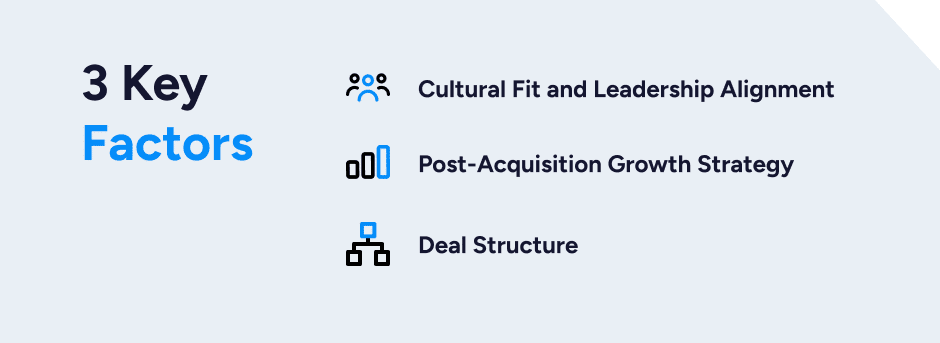
Not all offers are created equal, even when the headline number looks the same. What distinguishes buyers in practice comes down to three areas that founders sometimes underweight early in the process.
The first is cultural fit and leadership alignment. How a buyer thinks about your team, your role, and your decision-making authority after close shapes what the business looks and feels like once the transaction is done. Strategic buyers may integrate your company into a larger organization. PE buyers may leave leadership largely intact while adding operational infrastructure. Search funds may transition leadership entirely. None of these is inherently better or worse. What matters is whether the buyer’s approach matches what you want your life and your company’s life to look like post-close. Talking to founders who have sold to the same buyer is one of the most reliable ways to understand this before signing anything.
The second is a post-acquisition growth strategy. Some buyers want to combine your business with existing products or customers to quickly generate synergies. Others are building platforms through add-on acquisitions and see your company as a foundation for something larger. Understanding which of these describes the buyer in front of you helps you anticipate how the business will evolve and whether that trajectory aligns with your own vision for it.
The third is deal structure. Two offers at the same valuation can produce very different outcomes depending on how the deal is structured. Consider this example. Offer A carries a $35 million earnout with restrictive terms and no representations and warranties insurance support. Offer B carries a low escrow, clean representations, and a founder-friendly structure. The headline price is identical. The actual outcome for the founder is not. Earnouts, equity rollovers, all-cash structures, holdbacks, and indemnity terms all affect both the risk a founder carries and the upside they can participate in. These details are worth understanding before evaluating any offer on its face.
How to Test for Fit Before You Commit
By the time you are deep in a process, the relationship with a buyer has already started. The conversations that happen before an LOI is signed reveal a great deal about how a buyer operates, what they prioritize, and how they treat the people they are working with.
A few questions that tend to surface meaningful information: How do you measure success for the companies you acquire? What does your involvement look like in the first year after close? What resources do you bring to support growth? How have you handled situations in which the business underperformed?
The answers matter less than the pattern they reveal. Buyers who have thought carefully about post-close dynamics, who can speak specifically about past experiences, and who seem genuinely interested in what you are building tend to behave differently after close than buyers who are focused primarily on closing.
Jessie Yu, former CEO of EcoInteractive, reflected on what drove her final decision: her priority was finding a buyer with as much conviction in the business as her own board had. She was not looking for the highest number. She was looking for genuine belief in what the business could become. That conviction, she found, was something a structured process was uniquely good at surfacing.
Fit Is What Determines the Outcome
A strong valuation and the right buyer are not mutually exclusive. Founders who approach this decision with clarity about their goals, an understanding of what different buyers are optimizing for, and a process designed to create genuine competition tend to achieve both.
The question worth sitting with before any offer is evaluated: Is this a buyer I would invest my own capital alongside? Would I roll equity with them? The answer tells you more about fit than any term sheet does.
Choosing a buyer is one of the few decisions in an M&A process where founders have more control than they often realize. Using that control well starts earlier than most expect and requires more than comparing numbers.
About the Author
Daniel Bowen spent a decade on the buy side before joining SEG, including time as Vice President of Corporate Development at RealPage, where he led acquisition strategy and oversaw more than 30 transactions. In that role, he was evaluating sellers, reviewing what they built, and deciding which ones fit. He sat in the investment committee meetings. He watched which founders had prepared well and which had not, and he saw how buyer intent played out after close in ways sellers rarely anticipated.
That experience shapes how he works with founders today. Understanding what a buyer is optimizing for, and whether it aligns with what a founder needs, is a question he has spent his career on both sides of. He brings that perspective to every process he runs at SEG.