An overview of our sell-side M&A services








5 Financial Mistakes That Kill SaaS Valuations (and How to Avoid Them)

Even strong SaaS companies can lose millions in valuation, but not because the product is weak or growth is stalling. They lose value because their financial story doesn’t hold up under scrutiny.
Clean growth alone isn’t enough. During diligence, messy data, unclear metrics, and last-minute financial cleanup slow the process, raise questions buyers weren’t planning to ask, and shift leverage away from founders.
Financial readiness is not about “perfect books.” Founders need to show discipline, clarity, and the ability to show how the business really works. Founders who build that discipline early protect valuation and put themselves in a stronger negotiating position.
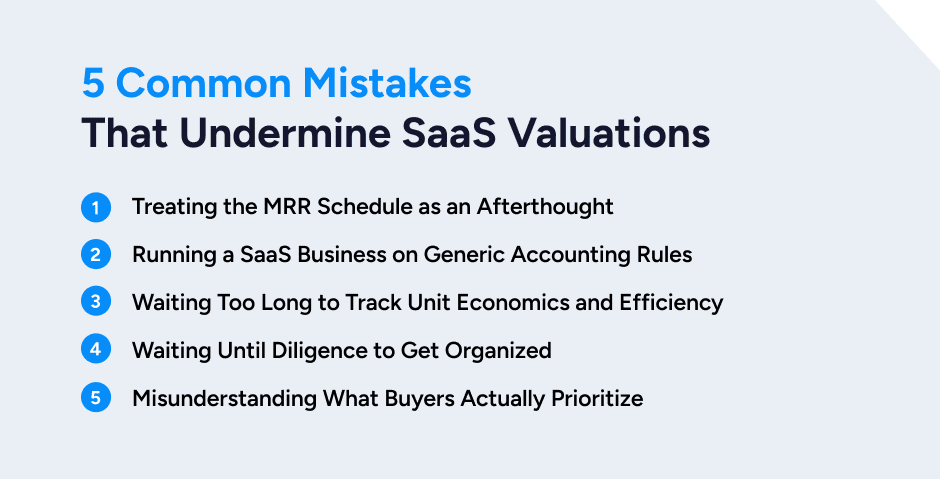
Below are five of the most common financial mistakes that undermine SaaS valuations and how to avoid them.
Mistake #1: Treating the MRR Schedule as an Afterthought
Many SaaS companies technically track recurring revenue, but their MRR schedules are incomplete, inconsistent, or built only for internal reporting. Subscription start dates are unclear, expansions and contractions aren’t cleanly separated, customer turnover is blended into totals, and historical MRR doesn’t tie cleanly to bookings or invoices. In some cases, the schedule doesn’t exist at all until diligence begins.
Why it matters:
For buyers, the MRR schedule is one of the fastest ways to assess revenue quality, predictability, and risk. It answers critical questions immediately:
- How much revenue is truly recurring (and what isn’t)?
- How durable is the existing customer base over time?
- What drives net growth: expansion within the base, new customers, or just replacement of churn?
- How much revenue is at risk in the next 6–12 months based on renewals and customer concentration?
When this information isn’t clear, buyers can’t confidently underwrite. That uncertainty slows diligence, increases scrutiny, and often results in conservative assumptions around churn, growth, and durability. That shows up in valuation and deal terms. Learn more about MRR schedules.
How to avoid it:
Build and maintain a clean, auditable MRR schedule well before a transaction. It should clearly show customer-level recurring revenue by month and by product, including new MRR, expansion, contraction, and churn, with consistent definitions over time. A strong MRR schedule allows a buyer to understand how revenue behaves. When buyers can see stability and predictability in the numbers, value follows.
Mistake #2: Running a SaaS Business on Generic Accounting Rules
Many SaaS founders rely on out-of-the-box accounting structures that were designed for service firms or small businesses. Default charts of accounts lump most expenses into broad G&A categories, while COGS is underdefined, inconsistently applied, or treated as an afterthought. The result is financials that technically balance, but don’t reflect how a SaaS business operates or scales.
Why it matters:
SaaS companies are fundamentally different. Buyers want to know the business creates, delivers, and supports recurring revenue. They want to see clear separation between:
- Revenue generation (sales and marketing)
- Product creation (R&D)
- Revenue delivery and retention (customer success and support)
- True cost of revenue (hosting, support/implementation labor, third-party services)
When expenses and COGS aren’t structured this way, buyers can’t assess gross margin quality, operating leverage, or scalability. That uncertainty forces more diligence, invites skepticism around efficiency, and often leads buyers to normalize the numbers themselves. That rarely goes in the founder’s favor. When buyers ask questions like “What does it cost to retain a dollar of ARR?” or “Where does margin expansion come from?” vague answers and hesitation are red flags.
How to avoid it:
Design your financial structure to reflect a SaaS operating model, not a generic accounting template. Define COGS clearly and apply it consistently. Break operating expenses into functional categories that mirror how value is created and delivered in the business.
Even at lower ARR levels, this discipline creates a reliable financial history and makes unit economics, margin expansion, and scale efficiency visible long before a transaction is on the table.
Mistake #3: Waiting Too Long to Track Unit Economics and Efficiency
Many founders wait until $10M+ ARR to track key SaaS performance metrics. Retention may be monitored at a high level, but deeper indicators like unit economics and sales efficiency are often missing or inconsistent. The assumption is that growth will carry valuation, and that these metrics can be reconstructed later if needed.
Why it matters:
Buyers are looking not only at what is growing, but how it grows. Metrics like Gross Revenue Retention (GRR), Net Revenue Retention (NRR), sales efficiency, and unit economics reveal whether growth is durable, repeatable, and scalable.
Without historical data, buyers can’t assess:
- Whether churn is improving or simply masked by new sales
- Whether expansion is structural or opportunistic
- Whether go-to-market efficiency is strengthening or deteriorating over time
When these metrics appear late or only at a point-in-time buyers are forced to assume risk, leading to lower confidence in forecasts, tighter deal structures, or valuation discounts.
How to avoid it:
Start tracking SaaS unit economics early, ideally by $3M ARR. In addition to GRR and NRR, monitor sales efficiency (how consistently revenue converts into profit), payback, and cohort-level performance so trends are visible over time and not reconstructed in diligence.
As the business scales, segment metrics by customer type, product, or channel. Founders who can clearly explain how retention, efficiency, and unit economics have evolved show operational discipline and give buyers fewer reasons to second-guess the story.
Mistake #4: Waiting Until Diligence to Get Organized
Founders who wait until a Letter of Intent (LOI) to organize data, metrics, contracts, and documentation are already reacting, because diligence has begun. Rather than controlling the narrative, they’re stuck reacting to hundreds of buyer requests and scrambling to assemble materials under tight timelines. At that point, diligence stops being confirmatory and becomes investigative.
Why it matters:
Diligence is when every assumption about your business gets verified and every number gets tested. When buyers encounter disorganization such as missing documents, inconsistent reporting, or unclear historic metrics, diligence slows, confidence erodes, and leverage shifts to the buyer. Even small inconsistencies can trigger delays, induce renegotiation pressure (re-trades), or introduce risk provisions that reduce value.
Preparation positions your team to make due diligence confirmatory, not discovery, meaning buyers validate what they already understand rather than uncover surprises. Sellers who prepare shorten the diligence process; reduce friction between financial, legal, and SaaS diligence workstreams; and keep the deal moving confidently toward close.
How to avoid it:
Start assembling and organizing diligence materials long before a sale is imminent. Build a structured data room with reconciled financials, backed-up revenue and expense histories, customer contracts, SaaS metric definitions, and ownership documentation. Assign clear owners for each section so that responses are timely and consistent. Founders who enter diligence ready keep the focus on value. They protect momentum, reduce scrutiny, and preserve leverage throughout the process.
Mistake #5: Misunderstanding What Buyers Actually Prioritize
Different buyers are solving different problems. Founders often assume growth alone drives valuation or that strategic buyers will automatically pay more than financial buyers. In reality, valuation depends on how relevant your growth is to a specific buyer.
Why it matters:
When founders present a single, generic financial story, they force buyers to translate relevance themselves. Some won’t.
Private equity buyers generally focus on predictability and returns. They scrutinize efficiency, retention, margins, cash generation, and operating leverage. Metrics like GRR, NRR, CAC payback, and contribution margins feed directly into their models.
Strategic buyers also care about retention and profitability, but they are also more focused on fit. They evaluate how an acquisition accelerates their roadmap, expands their market, fills a product gap, or strengthens a competitive position. Financial performance is viewed through the lens of long-term strategic impact, not just near-term efficiency.
Valuation outcomes are driven by alignment. Buyers who clearly understand why your company matters to their next chapter move faster, push harder, and compete more aggressively.
Another common mistake is assuming buyer behavior based on labels instead of incentives. Private equity is not monolithic. Some firms behave like strategics, underwriting integration and category leadership, while others remain purely financially driven. Knowing which incentives matter is as important as knowing whether a buyer is private equity or strategic.
How to avoid it:
Start by understanding your likely buyer universe well before a process begins. That means knowing who would care most about your business and why. For private equity buyers, emphasize repeatability, operating leverage, and downside protection. Show how growth converts into durable cash flows and predictable outcomes.
For strategic buyers, highlight where your metrics intersect with strategic impact. Explain how your customer base, product capabilities, or market position opens growth opportunities they can’t achieve organically.
Valuation is about positioning those numbers in a way that makes the business relevant to the right audience. Founders who understand this can position the same company in very different and far more compelling ways.
This is where experienced advisors come in: by helping founders identify the right buyer universe and tailor the financial and strategic narrative to what each buyer values.
How Buyers Interpret Financial Readiness
In a SEG webinar with Ben Murray of The SaaS CFO, he put it simply:
“Run your business like you’re always for sale.”
That mindset is about building financial discipline, clarity, and credibility before a buyer is involved. The companies that command the strongest outcomes aren’t scrambling to explain their numbers. Their data already tells a coherent, defensible story.
If you want to understand how your financial readiness compares to investor expectations, explore SEG’s SaaS Scorecard or watch the full on-demand conversation with Ben Murray to see how buyers really evaluate value.