An overview of our sell-side M&A services







Why Customer Churn Analysis is Important in SaaS M&A

Few metrics matter more to buyers and investors in an M&A process than customer retention.
Simply put, customer churn is the rate at which customers are leaving your business or spending less. In SaaS, that’s typically customers canceling their subscriptions or downgrading their service.
Churn is like a hole in the bottom of a bucket, draining your company of much-needed revenue. To keep the bucket full, you need to either add more customers or slow the leak.
Understanding and improving customer churn is important for SaaS companies. Without a base of recurring customers, a SaaS business won’t be able to pay its employees and meet other obligations, let alone make a profit. In most cases, keeping existing customers is easier and less expensive than finding new ones, so smart SaaS companies prioritize keeping current customers happy. As an M&A advisor to SaaS companies, Software Equity Group guides leaders on how to improve churn rates before a liquidity event.
Why Customer Churn in SaaS Matters to Investors
High customer churn can indicate underlying issues that raise red flags, including:
- Product market misfit. The product may not be meeting customers’ needs.
- Weak adoption. When users don’t fully engage, it’s usually due to poor onboarding, lack of ongoing training, or bad UX.
- Limited competitive moat. If customers are leaving, it means that an offering could be easily replaced.
- Challenges in scaling the business. High customer churn makes it difficult to scale revenue.
- Service gaps. High customer churn could be due to inconsistent or unresponsive customer support.
- Performance issues. Downtime or bugs can frustrate users, pushing them away.
- Internal blind spots. High customer churn may indicate internal misalignment between departments.
Any of the above introduce risk to the SaaS business’s long-term prospects and, as a result, lowers valuations. Plugging the hole in the bucket should be a priority for any SaaS company. A low churn rate indicates that your customers are satisfied and will continue to provide a reliable source of recurring revenue. It also indicates that the solution is resilient (a down market won’t significantly increase churn) and mission critical (customers need the product). That leads buyers to pay more for your business.
It’s as important to know what types of customers are leaving and how many, as it is to understand their reasons. Jeremy Holland, Managing Partner at The Riverside Company, said:
“It would be hugely valuable if companies tracked why customers churned. It is different if the customer went out of business than if they chose to go to a cheaper competitor. Or, say, they went to a cheaper competitor but came back two years later. It is validation. that they tried the competitor, and it didn’t work out. If companies took the time to track ‘the why,’ there would be a tremendous amount of insight into the existing metrics.”
What is Customer Churn Analysis in SaaS?
Buyers want to see evidence that you’re serving customers well. SaaS companies should measure four types of churn:
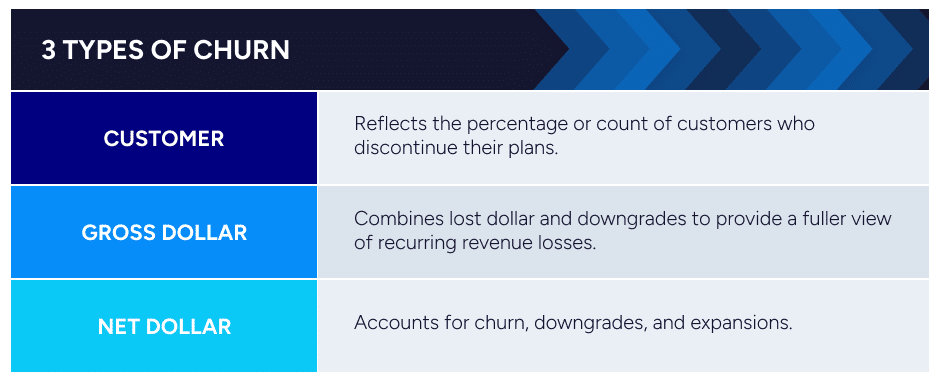
- Customer: Also known as logo churn, this reflects the percentage or count of customers who discontinue their plans. It brings customer retention challenges to the forefront, and highlights areas for improving loyalty. On the other hand, low churn in certain segments may point to where your product is working. You can use that insight to strengthen your growth strategy.
- Gross dollar: This combines lost dollar and downgrades to provide a fuller view of recurring revenue losses, crucial for forecasting and budgeting. A lower gross churn rate shows that customers are staying put.
- Net dollar: This metric accounts for churn, downgrades, and expansions. A positive NRR shows that upsells and cross-sells are offsetting losses, that existing customers are growing with your product. For buyers, that validates product-market fit and growth potential.
While calculating your customer churn rate may seem straightforward, the real value comes from understanding what your data says about strengths and weaknesses. At SEG, we help SaaS companies understand ARR by customer, making it complete and accurate for both internal decisions and M&A conversations.
We also perform customer segmentation to uncover patterns in churn. For example, if customers in a vertical show high retention, that may be an opportunity to niche down or tailor messaging. If churn is directly related to a feature, it may indicate gaps.
Conducting a recurring monthly churn analysis can help SaaS companies make course corrections. Failing to act can lead to poor strategic decisions, misallocated resources, and missed opportunities. It may also cause leaders to overlook areas of the business that may be bleeding cash.
But done right, churn analysis can be a growth tool, showing you where to double down.
How to Reduce Customer Churn in SaaS
An analysis of churn data, coupled with additional research such as qualitative customer surveys, can produce insights SaaS companies need to improve retention. Customers leave for many reasons, some of which may be beyond your control. More often, however, feedback will provide valuable guidance. Here are areas where focused improvements could make a significant impact on customer churn.

Making Sure Your Product is Differentiated
The most important step to reducing churn is making sure your product is differentiated and delivering clear value. If it’s not, customers will leave. By monitoring usage data and customer feedback, you can better understand what customers value most and where competitors may be catching up.
Targeting the Right Customers
Software companies in the early growth stage may be eager to do business with just about anyone. But not all customers are good customers. Selling to customers who aren’t the right fit only leads to a revolving door of come-and-go clients and leaves your company spinning its wheels instead of driving business growth.
Andrea Pitts, the Senior Vice President of PTC Velocity Global Sales, described in an SEG webinar how her company improved retention by targeting the right customers: “We instantly recognized which portion of our base was bad for our business. Retention rates were in the 60s and 70s when our goal was to get to over 90.”
Over the next year, the company weeded out undesirable customers by setting a minimum ARR. “It was tough,” says Andrea. But the results were worth it when they achieved their four-year Gross Retention Rate goal in just over a year.
Develop relationships with customers who will:
- get real value from your product
- make a long-term commitment
- have financial stability to pay their bills each month
Getting Implementation Right
The roll-out sets the tone for the rest of the customer relationship. If an implementation is disorganized and confusing, the customer will likely experience low adoption rates and little ROI from your product (and they won’t be a customer for long). Conversely, a well-planned rollout that adheres to proven best practices can help the customer get the most from the software and pave the way for long-term loyalty.
Providing Better Customer Support
At some point in the customer’s experience, they will likely need help. Will competent professionals answer quickly, or will it take days to receive a scripted response from an untrained third party? The former is more likely to result in satisfied customers and decreased churn.
Improving Sales & Marketing Alignment
High customer churn often indicates a disconnect between what’s being sold and what’s being delivered to your customers. Closer collaboration between sales and marketing teams can help you refine messaging, target the right customer segments, and set clearer expectations for customers.
That also means better onboarding, stronger value communication, and more personalized engagement with existing customers.
Informing Planning
A SaaS company that understands its churn metrics is better positioned to plan: where to focus, pivot and pull back. Investors see reduced churn as a sign of stability, especially when the market is uncertain. It shows that you understand your customers and are building a business that has long-term value.
A lower churn rate means higher customer lifetime value (CLV). That improves overall profitability. Retained customers tend to spend more over time, which boosts your Net Revenue Retention (NRR), which is the percentage of revenue retained from existing customers over a specific period. A higher NRR is less risky and more likely to provide returns for investors.
Customer Acquisition Cost (CAC) also goes down with lower customer churn, as you’re spending less money replacing lost customers. This also makes the business more attractive to customers.
If you plan to seek investment in your business, turn to an experienced advisor who can help you with customer churn analysis and can recommend the improvements buyers care most about. The extra effort will pay off in a higher valuation for the company you built.
Contact SEG to get started today.