An overview of our sell-side M&A services








How Go Get Analysis Impacts Software Company Valuation

How Your Go Get Analysis Determines Your Company Valuation
You’ve spent five years growing your SaaS business to $15 million in ARR with 40% year-over-year growth, strong gross margins, and solid retention metrics. When you decide it is time to explore a transaction, early conversations with buyers go well. Everyone loves your market position and your product.
Then a buyer asks:
“You are projecting $18 million by year-end. Walk me through exactly how you get there.”
This is the moment where everything you have learned in Parts 1, 2, and 3 of this series on Go Get Analysis pays off or costs you millions. The buyer is not just asking this question out of curiosity.
Your answer will shape how they value your business. Companies that can deconstruct their growth with precision get valued on forward ARR, while companies that cannot do that get valued on spot ARR, or the revenue it has right now. In a $15 million ARR business, that can translate to a difference of $10 million to $20 million in purchase price.
Let’s walk through how buyers scrutinize your Go Get, why it directly impacts valuation, and how the operating discipline behind it can become an advantage during a transaction.
Why Buyers Care About Your Go Get So Much
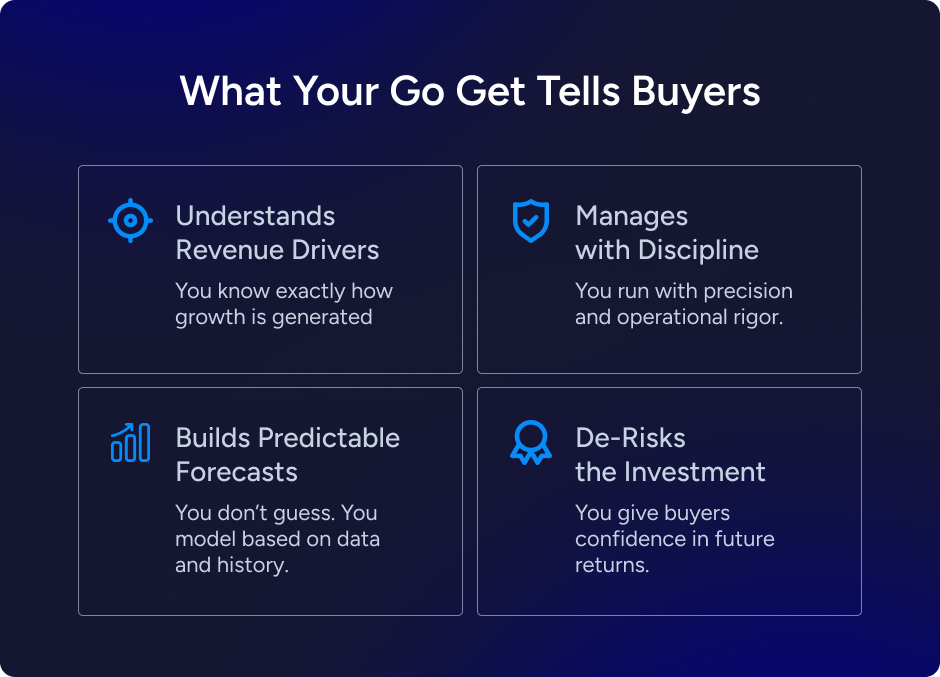
When a buyer evaluates your business, one of the key questions they want to know is: How predictable is the future revenue stream I am buying?
They can see that you grew from $10 million to $15 million over the past 12 months. That is impressive, but it is backward looking. What really matters is whether your growth engine is repeatable and predictable.
This is where Go Get analysis comes in. A credible Go Get demonstrates that you understand how revenue is generated in your business. It shows that you are not guessing about your forecast. You are building it based on what is already contracted, what is in your pipeline, and what your historical conversion rates indicate is realistic.
Buyers also use your Go Get to stress-test your forecast. A strong Go Get can withstand this because it is built on well-informed, data-supported assumptions and has adequate coverage.
Perhaps most importantly, your Go Get reveals how you run your business. A CEO who can produce a detailed, accurate Go Get on demand is a CEO who manages with precision, which is something buyers pay premiums for.
Spot ARR vs. Forward ARR: Where Millions in Valuation Are Won or Lost
In most SaaS transactions, buyers value companies as a multiple of ARR. But the question is: Which ARR?
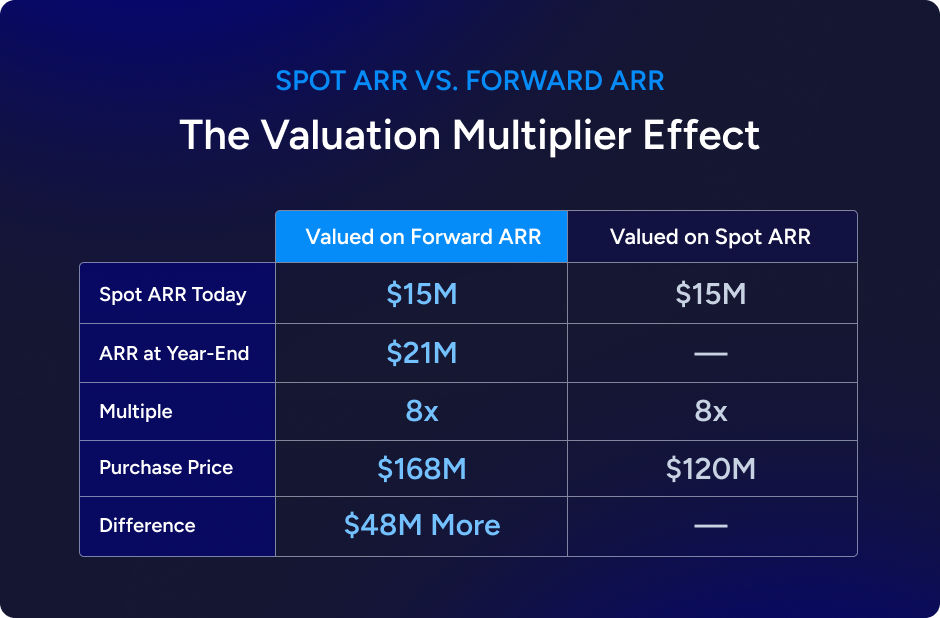
Spot ARR is your ARR as of today. If you are currently at $15 million, that is your spot ARR. Forward ARR is your ARR in the future, typically the end of the current fiscal year or 12 months from today. If you are at $15 million today and projecting $21 million at year-end, your forward ARR is $21 million.
The difference matters because buyers are more willing to apply their multiple to Forward ARR if they have a high degree of conviction in the forecast. If a buyer is willing to pay 8x ARR, the question is whether they are paying 8x your $15 million spot ARR ($120 million purchase price) or 8x your $21 million forward ARR ($168 million purchase price). That is a $48 million difference.
Buyers default to spot ARR unless you can convince them that your forward ARR is highly predictable. The way you convince them is through a credible Go Get analysis. If you can demonstrate how you are getting from $15 million to $21 million, show them adequate pipeline coverage, prove that your assumptions are grounded in historical data and withstand their stress testing, they are far more likely to give you credit for that future ARR.
But if your Go Get is shaky, your pipeline coverage is thin, your assumptions do not hold up to scrutiny, or you cannot answer their questions with specificity, they will fall back to spot ARR. They may even discount below spot ARR if they believe your current run rate is unsustainable.
This is why we see such dramatic valuation differences between companies that have mastered Go Get analysis and companies that have not. Two companies with identical spot ARR, identical growth rates, and identical retention metrics can receive offers that differ by 30% to 40% based on the buyer’s confidence in the predictability of future growth.
How Buyers Pressure-Test Your Go Get
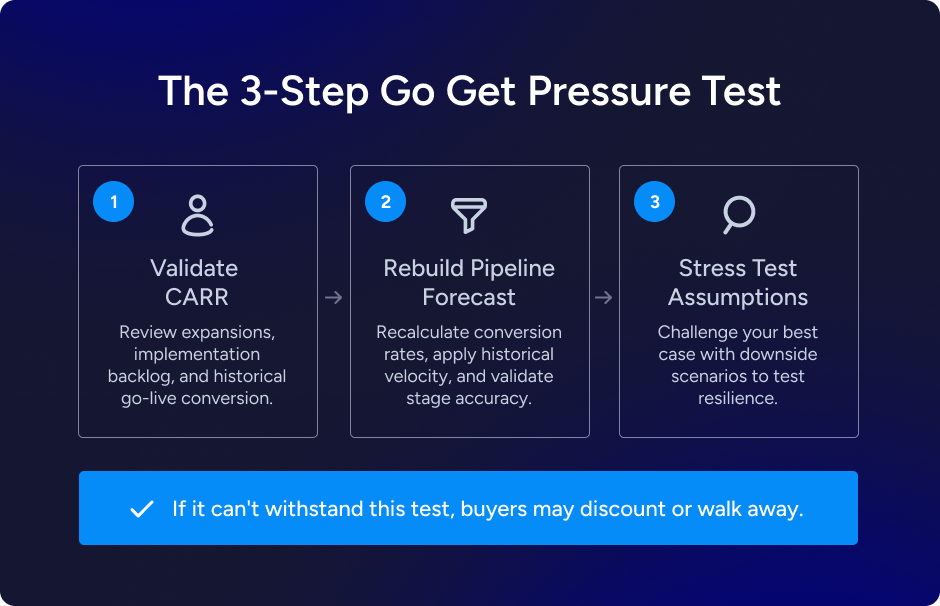
Let’s walk through what happens when a buyer puts your Go Get under the microscope.
Step 1: Validate CARR.
Existing Customer Price Increases & Expansions
The buyer will start with your existing live customer base. They will ask you to document every scheduled price increase between now and your target date. If you project $200,000 of ARR from pricing with minimal churn, they will expect evidence that supports the assumption. They will also want to understand any anticipated expansions from your existing customer base (for example, a customer going from three modules used to four).
Implementation Backlog Review
Next comes your implementation backlog. Buyers will want a detailed list of every signed customer that has not launched, including expected go-live dates, ARR value, time in implementation, and recent activity. They will compare your projected launch assumptions against historical performance. If you claim that 95% of customers in implementation eventually go live, they want to see the data. They will also focus on stalled accounts and ask why certain customers have been sitting in implementation for longer than your historical average.
Step 2: Rebuild the pipeline forecast.
Pipeline Structure
Then the scrutiny shifts to pipeline quality. Buyers will request a full pipeline export with opportunity amount, stage, probability, source, activity history, and expected close dates. From there, they will segment the pipeline by deal size, customer type, and age. They will calculate their own weighted pipeline and coverage ratios rather than relying on yours.
They will compare your stage probabilities against historical conversion data. If Discovery-stage deals historically convert at 22% but your model weights them at 35%, they will adjust the forecast downward, absent a compelling reason why conversion rates in the future will be higher than the past.
Sales Cycle Analysis
They will also analyze sales cycle timing. If your average deal takes six months to close, but a newly created opportunity is forecast to close in eight weeks, they will want to understand why the timeline is accelerated for this opportunity. Otherwise, they may push the revenue out.
Pipeline Hygiene
Pipeline hygiene becomes another focus area. Buyers will filter for opportunities with no activity in the last 60-90 days or beyond however long is typical between prospect touchpoints for your sales team. They will examine deals with repeatedly pushed close dates and ask whether those opportunities are real or simply optimistic forecasting.
Step 3: Pressure-test the largest deals.
Top Deal Scrutiny
For the top opportunities in your pipeline, they will want to understand the champion, stakeholders, urgency, objections, competitive landscape, procurement process, recent conversations, and next steps. They are trying to determine whether the deal is progressing or merely being discussed.
Scenario Testing
Finally, they will run downside scenarios. What happens if win rates decline by 5 percentage points? What if your top three deals slip out of the quarter? What if churn comes in above plan? Buyers will stress-test the model to see how quickly the forecast breaks and whether management has a credible contingency plan.
How Predictability Changes Deal Outcomes
Valuation Multiple Expansion
Predictability directly impacts valuation. Let’s examine two real scenarios we have observed in transactions, with details anonymized. Both companies are at $12 million ARR. Both are projecting $16 million by year-end. Both are growing at similar rates and operate in attractive markets.
But when buyers begin diligence, the outcomes diverge.
Company A can clearly walk buyers through its Go Get. The CEO produces a detailed bridge showing contracted ARR growth, implementation launches, weighted pipeline coverage, historical conversion rates, and downside scenarios. The assumptions are conservative, the data is clean, and the forecast withstands stress testing. Buyers gain confidence that the company will realistically reach $16 million ARR and agree to value the business on forward ARR.
Result: At a 7x multiple, the company receives a $112 million valuation.
Company B cannot support its projections with the same level of precision. The pipeline contains stale opportunities, conversion assumptions are overly aggressive, and close dates do not align with historical sales cycles. When buyers rebuild the forecast themselves, they conclude the year-end target is unlikely to be achieved. Instead of underwriting future growth, they fall back to spot ARR.
Result: At the same 7x multiple, the company receives an $84 million valuation.
Same ARR and similar growth profile, but a nearly $30 million difference in purchase price. The difference is not the product or the market; it is buyer confidence in the predictability of revenue.
Better Deal Terms
Predictability also affects how a deal gets structured. When buyers lack confidence in the forecast, they push risk back onto the seller. That can come in the form of an earnout, more seller financing, rollover equity, etc. They might offer $100 million, but only $70 million upfront with $30 million contingent on hitting targets over the next 12 to 24 months.
A strong Go Get reduces that uncertainty. If buyers believe the forecast is credible and well supported, they are more willing to pay cash upfront because they feel confident in the revenue stream. They spend less time debating downside scenarios and less energy trying to protect themselves through complicated deal mechanics.
Strong operating discipline can also reduce friction during diligence. Clean pipeline data, documented assumptions, and defensible metrics create confidence that the broader business is being run with the same level of rigor. That trust can accelerate the timeline, reduce retrading risk, and keep momentum moving toward close.
Stronger Buyer Competition
Predictability creates greater competitive tension among buyers. Buyers move faster and bid more aggressively because they understand what they are buying. Internal investment committees are easier to persuade, and financing conversations are smoother.
Meanwhile, buyers who cannot get comfortable with the forecast slow down or lower their bids to compensate for the perceived risk.
This is one of the advantages of strong Go Get analysis. It does not just improve valuation mathematically. It changes buyer psychology. A buyer who trusts the predictability of your growth engine behaves very differently from one who feels uncertain about what happens after closing.
Preparing Your Go Get for Diligence
If you are considering a transaction within the next six to 12 months, here’s what you should be doing now to ensure your Go Get analysis holds up under buyer scrutiny.
Start running monthly Go Get reviews.
Build the six-month rolling analysis we described in Part 3. Track your accuracy over time. When you can show a buyer that you have been hitting your internal targets consistently and refining your assumptions based on actual results, that is powerful evidence of predictability.
Clean up your pipeline hygiene.
Close-lost any deals that have not had activity for an extended period of time. Fix unrealistic close dates. Ensure your stage definitions are clear and consistently applied. Get your weighted pipeline to a place where you trust it, because buyers will scrutinize it.
Document your historical conversion rates by stage, segment, and source.
Pull 18 to 24 months of data and calculate win rates. Build a dashboard that shows these metrics and update it quarterly. You will need this data to defend your probability assumptions in diligence.
Start tracking the metrics that connect to your Go Get.
Customer health scores inform your churn assumptions. Implementation success rates validate your pending launch projections. Sales cycle length by segment supports your close date assumptions. These all need to be documented and defensible.
Prepare your top deal narratives.
For your 15 to 20 largest pipeline opportunities, write up one-page summaries with all the relevant context. Deal size, stage, key stakeholders, competitive situation, timeline, risks, and mitigating factors. Having these ready shows buyers you are on top of your business.
What Buyers Scrutinize Beyond Go Get
While the Go Get is one of the most important analysis in diligence, it is not the only thing buyers care about. Let’s briefly touch on the other areas where operating discipline matters and how it ties to Go Get.
Retention Metrics
Buyers will want to see gross retention and net retention by cohort. They will want to understand why customers churn and what you are doing to address it. They will look at your customer health scores and ask whether there are any large customers at risk. Your Go Get churn assumptions need to tie directly to what your retention data shows.
Unit Economics
What is your CAC (Customer Acquisition Cost)? What is your CAC payback period? What is your LTV-to-CAC ratio? This helps buyers understand what worked and what hasn’t with your go-to-market efforts to date, as well as where additional sales and marketing investment would generate the most return.
Revenue Concentration
If 40% of your ARR comes from your top 10 customers, that is a risk factor. If one customer represents 15% of your ARR, they will want to understand that relationship in detail and assess the renewal risk. This connects back to your Go Get because high concentration means higher variance in your forecast.
Team and Organizational Structure
Do you have the leadership bench to execute your growth plan? Is your sales team quota-carrying and productive? Is there key-person risk with your founders or executives? A strong team gives buyers confidence that the Go Get will be achieved.
Technology Infrastructure and Product Roadmap
Are there technical debt issues that could slow you down? Are there competitive threats on the horizon? Does your product roadmap align with customer needs? These factors can accelerate or decelerate your growth trajectory.
Related: SaaS M&A Due Diligence Checklist
Common Go Get Mistakes That Hurt Valuation
Even companies that have decent operating discipline can make mistakes during diligence that undermine their valuation. Let’s address the most common ones we see.
Not having a Go Get analysis ready before entering a process
Some CEOs believe they can put it together once a buyer requests it. But if you are building your Go Get for the first time under the pressure of diligence, it will not be as clean or defensible as one you have been running for six months. Buyers can tell the difference between a Go Get that is part of your operating rhythm and one that was created for their benefit.
Overly optimistic assumptions
You want to show strong growth, so you weight your pipeline aggressively, assume the best-case conversion rates, and ignore sales cycle realities. Sophisticated buyers will see right through it. They will adjust your assumptions downward and then question your judgment. It is far better to be conservative and beat expectations than to be aggressive and fall short.
Not being able to defend your numbers
A buyer asks where your 45% demo-to-close conversion rate came from, and you say: “that is what my sales leader told me.” That is not going to work. You need to be able to say: “We analyzed the last 150 opportunities that reached Demo stage over the past 18 months, and 68 of them closed, which is 45.3%.” Precision matters.
Messy pipeline data
If your pipeline is filled with zombie deals, unrealistic close dates, and inconsistent stage definitions, buyers will assume your entire operation is sloppy. Even if your underlying business is strong, perception matters.
Not having a Plan B
Buyers will ask: What if your pipeline coverage drops? What if you lose a key deal? What if churn increases? If your answer is “That will not happen,” you have lost credibility. If your answer is “Here are the three levers we would pull to accelerate pipeline generation or reduce churn,” you have demonstrated that you are a thoughtful operator who plans for contingencies.
The Competitive Advantage of Operating Discipline
Companies that master Go Get analysis hit their numbers more consistently, identify problems earlier, and allocate resources more effectively. They build more credible plans and earn the trust of their boards and their teams. This all leads to better business outcomes.
When you eventually decide to sell, that discipline is visible to buyers. They can see it in how you present your business, how you answer questions, how your data is organized, and how confident you are in your forecast. That confidence makes buyers more aggressive in their pursuit and more willing to pay a premium.
The CEOs who command the highest valuations can demonstrate with precision that they have built a predictable, scalable growth engine that will continue to perform after the acquisition.
Your Go Get is the clearest expression of that predictability. Master it, and you do not just improve your chances of hitting this quarter’s target. You change how buyers perceive risk in your business, and you add millions of dollars in additional enterprise value.
Where to Go from Here
You now have the complete framework. You understand what a Go Get is, how to calculate it, how to weight your pipeline properly, the data infrastructure you need to maintain it, and why it matters so much to your valuation.
What will you do with this knowledge?
Start today. Build your first Go Get analysis this week using the framework from Part 1. Calculate your CARR. Determine your actual Go Get number. Pull your pipeline and weight it properly using the concepts from Part 2. Then set up the monthly review process from Part 3 and commit to running it for the next six months.
Six months from now, you will have a level of visibility into your business that most of your competitors do not have. You will make better decisions. You will hit your targets more consistently. When you do eventually decide to pursue a transaction, whether that is next year or in five years, you will command a premium valuation because you have proven you know exactly how your growth engine works.
The best time to start was six months ago. The second-best time is today.
This concludes our four-part series on Go Get analysis. If you found this valuable, start with Part 1: What Is a Go Get? to build your foundation.
About the Author
Noah Dickinson
Noah Dickinson works closely with SaaS founders and executives navigating the sale of their businesses. Since joining SEG in 2018, he has advised dozens of software companies across a wide range of verticals, helping management teams position their growth story, prepare for buyer diligence, and maximize valuation outcomes. Through that experience, Noah has seen firsthand how operational discipline, forecast credibility, and Go Get analysis directly influence buyer confidence, deal structure, and purchase price. Connect with Noah on LinkedIn.