An overview of our sell-side M&A services








Meet the Top Strategic Buyers Acquiring Software Companies
2025 marked the most active year on record for SaaS M&A, with strategic buyers playing a central role in driving it. Strategic buyers, including both privately held strategics and publicly traded strategics, accounted for 42% of all SaaS M&A transactions in 2025. This reinforces their influence over how software platforms evolve, consolidate, and scale.
Strategic acquirers are increasingly favoring highly targeted transactions designed to add specific capabilities. Many of these deals from 2025 focus on acquiring AI functionality, differentiated products, and specialized technical talent that can be integrated efficiently into existing platforms. The goal is straightforward: advance product roadmaps and expand platform capabilities in ways that are practical to integrate and scale across existing platforms.
For founders considering an exit, understanding how strategic buyers approach acquisitions provides important context. Strategic buyers vary widely in structure and priorities, and the strongest outcomes tend to come from alignment with a buyer whose roadmap and long-term objectives align with the business’s direction.
This list is informed by transaction data sourced from 451 Research and the SEG 2026 Annual SaaS Report. While we strive for accuracy, strategic acquirer activity and deal disclosures are not always comprehensive or consistently reported, and this list may not reflect every relevant transaction or buyer active in the market.
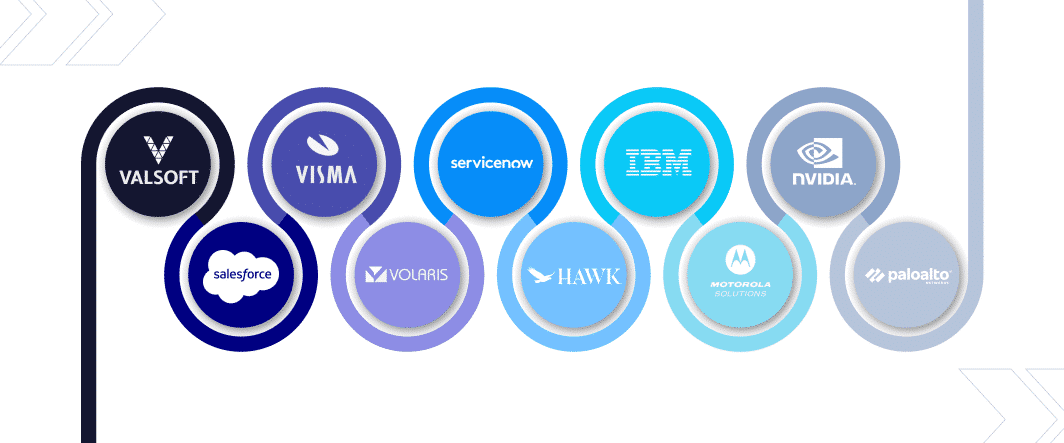
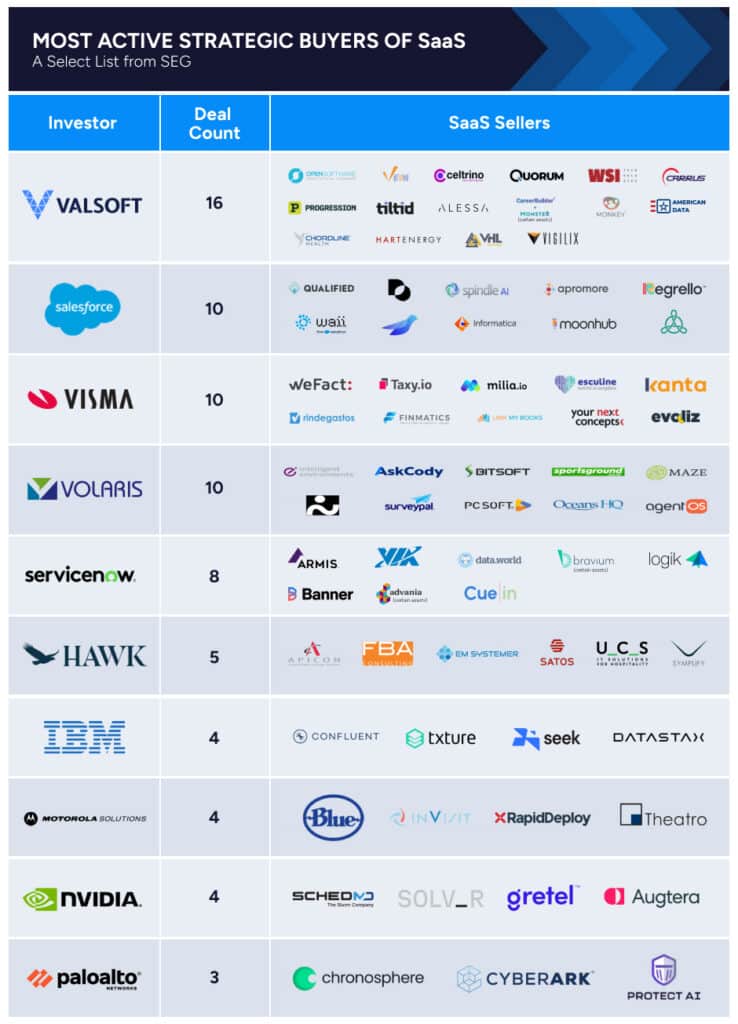
Below, we highlight ten of the most active strategic buyers in the SaaS M&A market and the 2025 acquisitions that offer insight into how each is positioning for growth ahead.
Valsoft
For the second year in a row, Valsoft ranked as the most active strategic buyer in SaaS. Valsoft is a Montreal-based holding company that acquires and operates mission-critical vertical market software businesses. The firm focuses on long-term ownership, allowing acquired companies to operate independently while providing stability, shared infrastructure, and operational support. Valsoft now supports a team of 700+ employees globally.
In 2025, Valsoft completed 16 acquisitions across various sectors, including automotive and dealership software, compliance and risk management platforms, and public safety technology.
Select Valsoft 2025 Transactions
In September 2025, Valsoft acquired WSI Technologies, a provider of secure video recording solutions for the public safety and child advocacy sectors. Founded in 1977, WSI’s platforms (including iRecord and Nexus) support secure interview recording, remote viewing, and evidence sharing for agencies and advocacy centers. Valsoft positioned the deal as its entry into the public safety vertical, with WSI serving as an anchor platform.
In June 2025, Valsoft acquired Alessa, a provider of anti-money laundering compliance and fraud prevention software. Founded in 2006, Alessa serves financial institutions and enterprises with tools that help detect and respond to financial crime risk. Valsoft described the acquisition as its entry into financial compliance and RegTech, expanding into a new vertical.
In December 2025, Valsoft closed its acquisition of Quorum Information Technologies, a North American SaaS provider of mission-critical solutions used by automotive dealerships and OEMs. Quorum’s software supports core dealership operations, and Valsoft noted the company would continue to operate autonomously within Valsoft’s decentralized model.
SEG-Advised Transaction
SEG recently served as the exclusive advisor to KidKare by Minute Menu, a provider of daycare management and Child and Adult Care Food Program (CACFP) compliance software for childcare sponsors, centers, and family providers. KidKare will operate within Valsoft’s Edelweiss Software Group, expanding Valsoft’s education and childcare software portfolio.
Salesforce
Salesforce (NYSE: CRM) is a San Francisco–based enterprise software company founded in 1999, best known for its cloud-based customer relationship management platform. The company serves enterprise and mid-market customers globally and operates a broad portfolio spanning sales, service, marketing, data, and analytics. Salesforce employs tens of thousands of people worldwide and remains one of the largest pure-play software companies by market capitalization.
Salesforce was one of the most active strategic buyers in 2025, completing 10 acquisitions as part of an aggressive effort to accelerate its Agentforce AI strategy. Across these transactions, the company focused on building a trusted enterprise data foundation and expanding its AI ecosystem, deploying more than $10.5 billion to strengthen data management, process intelligence, and automation capabilities that support agent-driven workflows.
Select Salesforce 2025 Transactions
In May 2025, Salesforce acquired Informatica (NYSE: INFA) in a cash offer valued at approximately $8 billion. Informatica is a global provider of enterprise cloud data management and integration software. Their platform helps large organizations unify, govern, and activate data across complex environments. The acquisition strengthens Salesforce’s trusted data foundation, a core pillar of its Agentforce AI strategy.
Convergence.ai is a UK-based AI company focused on building autonomous digital workers capable of executing complex tasks across enterprise systems. The company’s technology enables AI agents to navigate applications and automate multi-step workflows. Salesforce’s acquisition, announced in June 2025, expands its agent-driven automation capabilities.
In October 2025, Salesforce acquired Regrello, a cloud-based orchestration platform that helps enterprises coordinate workflows across teams and systems. Regrello’s software connects fragmented operational steps into structured, auditable processes. The acquisition enhances Salesforce’s ability to orchestrate and execute AI-enabled workflows at scale.
Visma
Visma is one of Europe’s largest providers of mission-critical cloud software, offering tools for accounting, payroll, and business management. Headquartered in Oslo, Norway, backed by a consortium of private equity investors including HG Capital, TPG, and Warburg Pincus, the company serves more than 2.2 million customers across 30+ countries and employs approximately 17,500 full-time employees worldwide, supported by a broad network of autonomous software companies. The group is backed by private equity investors and operates as a federation of entrepreneurial software businesses delivering cloud-first solutions across finance, HR, and operations.
In 2025, Visma continued its acquisition-driven expansion with ten software transactions across Europe, maintaining its focus on regulated industries and cloud-based workflow automation solutions.
Select Visma 2025 Transactions
Link My Books is a UK-based automated bookkeeping and e-commerce accounting platform that helps businesses reconcile sales data across multiple channels and accounting systems. The company’s automation reduces manual accounting work and improves data accuracy for small and mid-sized businesses. Visma acquired Link My Books in February 2025, expanding its cloud accounting automation offering and strengthening its presence in the UK market.
In August 2025, Visma strengthened its presence in the DACH region with the acquisitions of milia.io and Taxy.io, two AI-driven platforms focused on accounting and tax advisory workflows. milia.io’s platform automates internal accounting processes and client collaboration, while Taxy.io’s AI assistant helps tax professionals respond efficiently to complex tax inquiries. These deals enhance Visma’s AI-enabled automation capabilities for accountants and tax advisors.
Visma acquired Finmatics, a provider of AI-powered pre-accounting software serving accounting firms and SMBs in Austria and Germany. Finmatics automates financial processes such as document handling and data categorization, helping professional accountants streamline workflows. The acquisition broadens Visma’s automation and compliance-oriented accounting offering in core European markets.
Volaris Group
Volaris Group (NYSE: VLRS) is an operating group of Constellation Software Inc. focused on acquiring vertical market software businesses across regulated and mission-critical industries. Now one of Constellation’s largest operating groups, Volaris has completed 240+ acquisitions across 40 vertical markets and 60 countries, targeting companies with recurring revenue, diversified enterprise customers, and software embedded in daily operations. Its acquisition approach emphasizes long-term ownership and operational autonomy.
In 2025, Volaris completed ten acquisitions across multiple vertical-market software categories. The group operates under Constellation Software’s long-term buy-and-hold philosophy.
Select Volaris 2025 Transactions
In July 2025, Volaris Group acquired Surveypal Oy, a Finnish provider of automated survey and customer experience software. Surveypal’s tools help organizations collect and analyze feedback and deliver insights that support customer engagement and business intelligence. The acquisition expands Volaris’s presence in the Nordic software market and strengthens its portfolio of feedback-driven solutions.
In August 2025, Volaris Group acquired Maze Feedback, a Norway-based SaaS company offering customer experience and feedback software to retailers in Europe. Maze’s platform translates frontline data into actionable insights, helping stores improve performance and engagement. Volaris’s acquisition enhances its suite of analytics and CX-oriented vertical software.
In October 2025, Volaris Group acquired AskCody, a Denmark-based provider of workplace and meeting management solutions that optimize how organizations schedule and use space and resources. The AskCody platform integrates with Microsoft Outlook and Microsoft 365 to streamline meetings, visitor management, and workspace logistics. The acquisition adds enterprise workplace automation to Volaris’s portfolio.
ServiceNow
ServiceNow is a global enterprise software company best known for its cloud-based platform that automates IT service management, HR, customer workflows, and broader enterprise processes. Headquartered in Santa Clara, the company serves over 8,100 enterprise customers, including 85% of the Fortune 500, and employs approximately 32,000 people worldwide.
ServiceNow is back on our list, completing eight acquisitions in 2025. The company remains highly selective in its approach, typically acquiring niche technologies that extend native platform capabilities or accelerate product innovation in areas such as automation, observability, and secure collaboration. Many of these acquisitions are designed for rapid integration into the ServiceNow platform to expand workflow automation and AI-centric services.
Select ServiceNow 2025 Transactions
In January 2025, ServiceNow acquired Cuein, an AI-native conversation data analysis platform that enhances the company’s ability to interpret and transform customer interaction data into actionable insights for AI agents. Cuein’s capabilities help advance ServiceNow’s agentic AI roadmap by improving how the platform ingests and processes conversational and unstructured data across workflows.
In March 2025, ServiceNow agreed to acquire Moveworks for approximately $2.85 billion, combining its agentic AI and automation strengths with Moveworks’ front-end AI assistant, enterprise search, and autonomous reasoning technology. This acquisition significantly expands ServiceNow’s AI-driven workflow and employee engagement capabilities.
In July 2025, ServiceNow completed the acquisition of Data.World, a cloud-native data catalog and governance platform that enhances the ServiceNow AI Platform’s data intelligence and governance capabilities, supporting more effective AI-driven decision-making and workflow automation across enterprise systems.
Hawk Infinity Software
Hawk Infinity Software is a cloud-based software group headquartered in Norway, focused on acquiring and building mission-critical B2B software companies with recurring revenue and diversified enterprise customer bases. Hawk seeks companies with stable financial performance, asset-light business models, and solid barriers to entry, typically with minimum profit before tax of €1 million and strong, sustained growth. It also looks for founder- or family-owned businesses headquartered in Europe that it can support while preserving culture and long-term value.
Across marketing automation, energy management, vertical market software, and enterprise workflow platforms, Hawk added six new businesses to its portfolio in 2025.
Select Hawk 2025 Transactions
In February 2025, Hawk Infinity Software acquired Symplify Technologies, a Sweden-based provider of marketing automation and customer engagement software. The Symplify platform supports multichannel campaigns, customer journeys, and data-driven marketing workflows for enterprise and mid-market customers across Europe. The acquisition expands Hawk Infinity’s presence in recurring-revenue SaaS focused on customer engagement and marketing operations.
Satvision Software and EM Systemer were added to the Hawk Infinity portfolio following agreements announced in June 2025, expanding the group’s footprint in industrial and energy-related software. Satvision develops operational software used in industrial and infrastructure environments, while EM Systemer provides energy management systems for technical buildings and facilities. Together, the acquisitions strengthen Hawk Infinity’s exposure to mission-critical software embedded in regulated and heavy infrastructure operations.
FBA Indaga Soft, acquired in July 2025, is a Spain-based SaaS provider focused on experience measurement and quality management software, primarily serving healthcare and service organizations. The platform helps institutions collect, analyze, and act on experience data, adding a differentiated vertical solution to Hawk Infinity’s portfolio.
IBM
IBM is a global enterprise technology company with a long-standing presence across hybrid cloud infrastructure, software, and consulting services. Headquartered in Armonk, New York, the company serves large enterprises and public sector organizations worldwide and employs more than 280,000 people globally. In recent years, IBM has increasingly focused its strategy around hybrid cloud and AI, anchored by its Watson AI platform.
IBM completed four acquisitions during the year, continuing a targeted M&A approach centered on strengthening data infrastructure, AI-native capabilities, and cloud modernization tooling. The company remains selective in its deal activity, prioritizing technologies that can be integrated into its broader hybrid cloud and AI ecosystem.
Select IBM 2025 Transactions
In February 2025, IBM acquired DataStax, a provider of cloud-native NoSQL database technology. DataStax supports large-scale, distributed data workloads used in real-time and AI-driven applications and employs approximately 600+ people. The acquisition strengthens IBM’s data infrastructure capabilities, supporting enterprise AI use cases.
Seek AI, acquired in June 2025, is an AI startup focused on enabling natural language access to enterprise data. The company’s platform allows business users to query complex datasets through conversational interfaces. The acquisition supports IBM’s Watsonx AI Labs initiative and expands its natural language analytics capabilities.
In October 2025, IBM acquired Txture, a European software company specializing in application landscape analysis and cloud migration planning. Txture employs approximately 100+ people and helps enterprises assess and modernize complex IT environments. The acquisition enhances IBM’s hybrid cloud transformation offerings, particularly for large organizations managing legacy infrastructure.
Motorola Solutions
Founded in 1928, Motorola Solutions (NYSE: MSI) is a global leader in mission-critical communications, public safety technology, and enterprise security software. Headquartered in Armonk, New York, the company serves government agencies, first responders, and enterprises worldwide with solutions that span secure communications networks, command-and-control software, video security, and AI-enabled analytics. Motorola Solutions employs approximately 21,000 people globally. In 2025, the company is on track to report about $11.6 billion in revenue, up from roughly $10.8 billion in 2024, driven by growth in software, services, and integrated safety and security solutions.
Select Motorola 2025 Transactions
RapidDeploy, acquired in February 2025, is a cloud-native Next Generation 911 (NG911) solution provider that accelerates emergency response with real-time call mapping and analytics for public safety agencies. RapidDeploy’s suite supports more than 1,600 emergency communications centers and integrates with Motorola Solutions’ VESTA platforms to enhance situational awareness and telecommunicator workflows.
InVisit is a cloud-based visitor management software provider that expands Motorola Solutions’ secure access and monitoring tools for enterprise environments such as commercial offices, healthcare facilities, and education campuses. The acquisition was announced in March 2025 and enhances the Avigilon Alta security suite with scalable visitor and facilities management capabilities.
Blue Eye Corporation, acquired in November 2025, is a provider of AI-powered security video monitoring (RVM) software. Blue Eye’s RVM platform delivers real-time threat detection, live verification, and voice interactivity that integrate with existing video management systems, strengthening Motorola Solutions’ video analytics and integrated security offerings.
NVIDIA
Founded in 1993, NVIDIA (NASDAQ: NVDA) is a global technology leader best known for its graphics processing units and accelerated computing platforms that power artificial intelligence, data centers, and high-performance computing. Headquartered in Santa Clara, California, NVIDIA sits at the center of modern AI infrastructure. NVIDIA employs approximately 36,000 people and reported record fiscal year 2025 revenue of roughly $130.5 billion, reflecting more than 110% year-over-year growth driven by sustained demand for AI computing.
NVIDIA completed four strategic acquisitions in 2025 across complementary AI and infrastructure software categories.
Select NVIDA 2025 Transactions
In March 2025, NVIDIA acquired Gretel Labs, a San Diego-based provider of synthetic data tools that help developers generate privacy-preserving datasets for training and validating AI models. The Gretel platform will be integrated into NVIDIA’s broader suite of generative AI services for developers, reinforcing the company’s push into AI-native data-centric tooling.
SchedMD joined NVIDIA in December 2025 as the company behind Slurm, the leading open-source workload management system used across high-performance computing (HPC) and AI environments. The acquisition strengthens NVIDIA’s software ecosystem by embedding critical scheduling and orchestration capabilities into its infrastructure stack while continuing to support Slurm as open-source software.
Solver (formerly Laredo Labs) was acquired by NVIDIA in September 2025. Solver is an AI software startup developing autonomous coding and AI developer tooling that automates complex programming tasks via natural language interfaces, expanding NVIDIA’s reach into software innovation that complements its hardware-accelerated AI platform.
Palo Alto Networks
Founded in 2005, Palo Alto Networks (NASDAQ: PANW) is a global cybersecurity company best known for its cloud-delivered security platforms spanning network security, cloud security, and AI-driven threat detection. Headquartered in Santa Clara, California, the company serves enterprises and government organizations worldwide with a unified security architecture designed to protect increasingly complex digital environments. Palo Alto Networks employs more than 14,000 people globally and reported over $8 billion in revenue in its most recent fiscal year, driven by continued demand for cloud and platform-based security solutions.
Palo Alto Networks completed three SaaS acquisitions during the year, reflecting a focused M&A strategy centered on identity security, cloud observability, and AI-native protection across the software supply chain.
Select Palo Alto Networks 2025 Transactions
In February 2025, Palo Alto Networks announced the acquisition of CyberArk Software (NASDAQ: CYBR), a global leader in identity security and privileged access management. CyberArk’s platform helps enterprises secure human and machine identities across cloud and on-premise environments. The acquisition significantly expands Palo Alto Networks’ identity security capabilities and reinforces its push toward a unified, platform-based security strategy.
Chronosphere, acquired in June 2025, is a cloud-native observability platform designed for modern, distributed environments. Chronosphere helps engineering teams monitor and troubleshoot complex cloud systems at scale. The acquisition strengthens Palo Alto Networks’ cloud security and observability offerings by improving visibility into cloud-native infrastructure and application performance.
Protect AI, acquired in October 2025, is an AI security company focused on safeguarding machine learning models, data pipelines, and AI applications. Protect AI’s tooling addresses emerging risks across the AI lifecycle, from development through deployment. The acquisition expands Palo Alto Networks’ capabilities in AI-native security as enterprises increasingly deploy AI-driven software systems.
Planning Your Next Chapter with Strategic Buyers
Understanding the strategic buyer landscape is a valuable step for software founders and executives who are thinking ahead. Strategic buyers each bring different priorities, timelines, and acquisition strategies, and knowing how your business fits into that ecosystem can help inform both long-term planning and near-term decision making.
Which buyers are most active in your vertical, and how closely do their objectives align with your product and customer base? Recognizing these patterns early can help clarify when it may be worth exploring conversations.
If you are starting to think about what comes next, we can help provide context. From recent buyer activity to how strategic processes are playing out in your market, we work with founders to evaluate options and prepare for the right opportunity at the right time.