An overview of our sell-side M&A services








Minority Investment: What SaaS Founders Should Know Before Selling a Stake

SaaS CEOs and founders regularly ask us whether they should consider accepting a minority investment instead of seeking majority investment or selling their businesses outright.
A minority investment is when a leader decides to sell less than 50% of the company. Above 50% is a majority investment. That 2% difference (or less) determines who has control over the company.
Although SEG is exclusively focused on helping our clients seek majority investments, we recognize the importance of this decision, and we’re always glad to talk it through with founders who find themselves at this crossroads. That said, we often speak with operators who’ve already taken on a minority investor and later realize those early decisions limited their ability to exit on their terms. Understanding the structure of a minority deal today is critical to preserving flexibility, value, and control in the future.
Welcoming minority stakes can be appealing, but they can come with real tradeoffs. In this article, I review the pros of minority deals for SaaS companies, as well as their potential pitfalls.
What Makes Minority Investments Seem Like a Good Idea?
At first glance, minority investments seem like an excellent way to raise capital without sacrificing control. They provide access to capital to enable growth or liquidity without needing to sell the business outright. Selling 10% of the company to an investor can fund strategic initiatives, for example, while also reducing your risk and liability if the business encounters turbulence.
Other pros of welcoming minority investors include:
- Investors may offer guidance, networks, and operational insight.
- A minority investment can validate the business model and increase credibility with future investors or partners.
- Founders may be able to raise more capital later at higher valuations, sell additional equity down the road, or buy out the minority investor depending on the deal structure.
- A minority deal can be less disruptive to the team, especially if the founder stays fully engaged.
That said, minority investors don’t bring as much to the table as majority investors. Although they want data and a voice in decision-making, what they provide in terms of strategic resources and guidance may not be as substantial.
Majority investors, on the other hand, are likely to put more wind in the company’s sails. They want to make sure that their investment pays off; they typically come with a playbook for sales, a strategy for opening markets, or a plan to professionalize your customer support team. They may have technological expertise or infrastructure resources that can take your operations to a new level.
The devil is in the details. Minority deals that seem simple on the surface come with fine print that can deliver less control than you expected. All too often, they can wind up limiting your ability to maneuver.
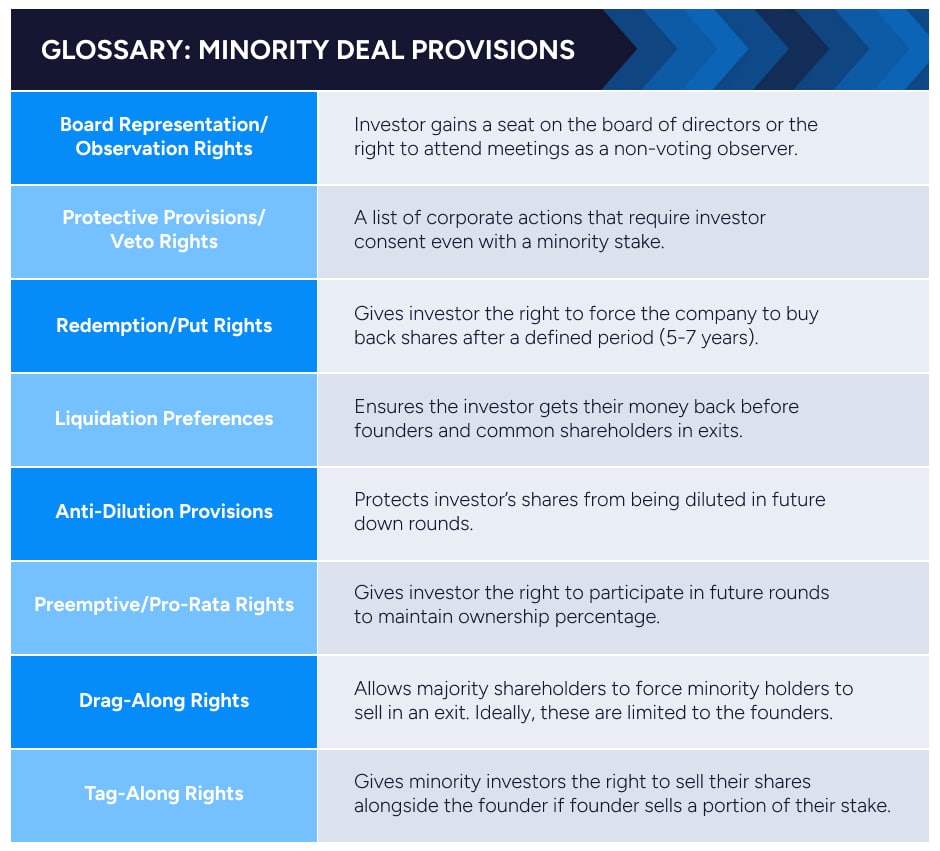
The Downsides of Minority Investments
Protective Provisions Resulting in Operational Handcuffs
To keep your business moving, you need all hands rowing in the same direction; now you have to share the oars with someone who might be steering by a different lodestar. The result can be a loss of control over strategic decisions or at least more hoops to jump through before consensus can be reached.
Even a minority investor who owns 10% of the company has the right to be informed about progress, planning, and success metrics. Minority investors may also seek board representation and other forms of oversight. And they may require veto rights over corporate actions such as fundraising, leadership changes, or business model shifts.
Founders who are used to trusting their own judgment and experience making decisions on the fly may miss that independence and maneuverability.
Redemption Rights Adding Liquidity Pressure
In some cases, investors may demand that the company buy back their shares after a specified period: typically five to seven years. The time pressure forced by redemption rights can put financial strain on the company, and in some cases may force the company into a premature sale, recapitalization, or fundraising efforts that may otherwise have been avoidable.
We’ve worked with founders who entered M&A conversations under significant pressure from redemption timelines only to discover that their leverage was reduced because of prior terms they hadn’t fully negotiated with future outcomes in mind.
Minority Investors Limiting Fundraising or Sale Opportunities
Another unintended side effect of minority investment is that it may wind up complicating or limiting the company’s fundraising or sale opportunities.
One potential cause is anti-dilution protections, which ensure early investors aren’t diluted in down rounds. While this protects investor interests, it can lead to greater dilution for founders and disincentivize new investors, especially if the protection uses a full ratchet mechanism. Full ratchet anti-dilution ensures early investors maintain their ownership percentage when new shares are issued at a lower price.
Minority investors may also seek pro rata rights, which ensures their shares are in the same class as the founders’. They might also lock in rights to participate in future rounds of investment.
Governance Drag
Governance drag refers to the way minority investments wind up with more influence over decision-making than founders want. As we’ve seen, this can be particularly onerous if the founder wants to seek more capital.
Two important provisions that highlight and can be used to help resolve tensions are drag-along rights and tag-along rights. It’s important to understand the distinction, because the former generally favors the interests of founders, while the latter may provide more advantages to minority investors.
- Drag-along rights provide majority investors with the ability to force a sale under certain circumstances such as if a potential buyer makes an offer to buy the whole company. For example, if a buyer wants to purchase 100% of the company but a 20% stakeholder refuses to sell, that might be a dealbreaker. Having drag-along rights in place can prevent a logjam where minority investors hinder a sale that’s in the best interests of the organization.
- Tag-along rights are the other side of the coin. This provision makes sure that minority shareholders are guaranteed the right to sell their shares at the same time as the majority shareholder, when a buyer is seeking to buy the whole company.
Both can be used to balance the competing interests of minority and majority shareholders in the event of a sale.
The best approach may be to set up a carefully negotiated buy-sell agreement that lays out exactly how shares will be bought and sold if a sale takes place. That way there are no surprises. But even in a best-case scenario, this may leave founders feeling like their hands are tied, ruling out options that would be attractive if there were no minority investors in the mix.
How Minority Investors Impact Exit Outcomes
Even if everyone is aligned on selling the business, when you do get into an M&A process, minority investors can create complexities in negotiation. Maybe they’re willing to sell, but they want to remain involved. But the buyer wants a simpler, cleaner capitalization table. That might become a sticking point.
Minority investors might also have different goals in terms of valuation. A founder who is more than happy with a $50 million valuation and ready to exit may discover that the minority investors are determined to hold out for $80 million, and in no hurry to settle for anything less.

It’s sometimes the case that minority investors want a larger return on their investment whereas founders may have other goals in mind related to their long-range vision. That dissonance can lead to frustration.
Another potential trap is that minority investors may insist on structured or participating preferred equity instead of common equity. This gives them liquidation preferences stipulating that in the event of a sale, they get paid their invested capital before founders and common shareholders. Non-participating liquidation preferences for the minority investor are better for the founder.
That can result in founders receiving far less than they’d hoped for.
Weigh the Risks and Rewards of a Minority Deal
Although minority investments can provide a needed infusion of capital, they come at a price and with risk that needs to be carefully evaluated. Make sure you understand the rights you’re granting to new investors, and the restrictions that may be embedded in these investment deals.
We’ve seen how even well-intentioned minority deals can limit great companies down the road. If you’re weighing a capital raise, exit, or strategic partner, we’re always happy to be a sounding board whether or not a transaction is imminent.