An overview of our sell-side M&A services







Inside the Data: How Software Leaders & Buyers Say AI is Reshaping Strategy and M&A

Artificial intelligence is reshaping the SaaS market more rapidly than any prior technology shift, and the market is responding in real time.
The results of SEG’s 2025 State of AI in SaaS survey show that the market has moved decisively beyond experimentation. But unlike earlier platform transitions, AI is already influencing valuations, compressing timelines and raising the bar for provable performance, often before companies feel fully ready.
What’s emerging is a clear divide. And that gap is changing how buyers assess risk, how investors set expectations, and how founders think about timing and optionality.
Here’s what the data shows:
- AI execution is the new dividing line, and the gap is widening. Everyone believes in the impact of AI, but few can deliver at scale.
- The valuation impact of AI is real.
- AI readiness and uncertainty are already having an impact on founders’ exit timing. Investor pressure is real, especially in PE- and VC-backed firms where valuation narratives must include AI strategy.
- AI adoption often begins with efficiency gains, but the market is rewarding leaders who move quickly to embed AI deeply into products, not those who stop at automation.
AI is not a future narrative or discretionary initiative. Companies that are not moving forward risk falling behind before they even realize the market has shifted.
What follows is a data-driven look at how software leaders are responding today, and how buyers are adjusting their expectations.
SEG’s AI Reset: How SaaS Founders Can Reinvent, Defend, or Exit Stronger examines how AI is reshaping durability, defensibility, and strategic optionality in software, and how founders can position their companies as buyers raise the bar. Read now
State of AI in SaaS Survey Methodology
We conducted the State of AI in SaaS survey in late 2025 to better understand how AI is influencing strategy, operations, valuation expectations, and exit planning across the software industry.
The survey included responses from 258 SaaS founders, CEOs, and senior executives across vertical and horizontal SaaS businesses headquartered in the United States. Respondents represent companies spanning multiple stages of scale, with a concentration in the $5 million to $50 million ARR range, as well as a meaningful subset of larger, scaled platforms.
Participants were asked about:
- Their current AI posture and investment priorities
- Perceived valuation impact of AI
- Competitive and execution risks related to AI
- Constraints to adoption and operationalization
- The influence of AI on strategic and exit timing decisions
Responses were analyzed in aggregate and segmented by ownership structure, where applicable, and by ARR range to identify meaningful differences in behavior and perception.
We also surveyed ~150 private equity and strategic buyers to understand how AI shows up in their target companies and how it factors into their investment decisions and valuations.
6 Findings That Show How AI Is Reshaping Value Creation in SaaS
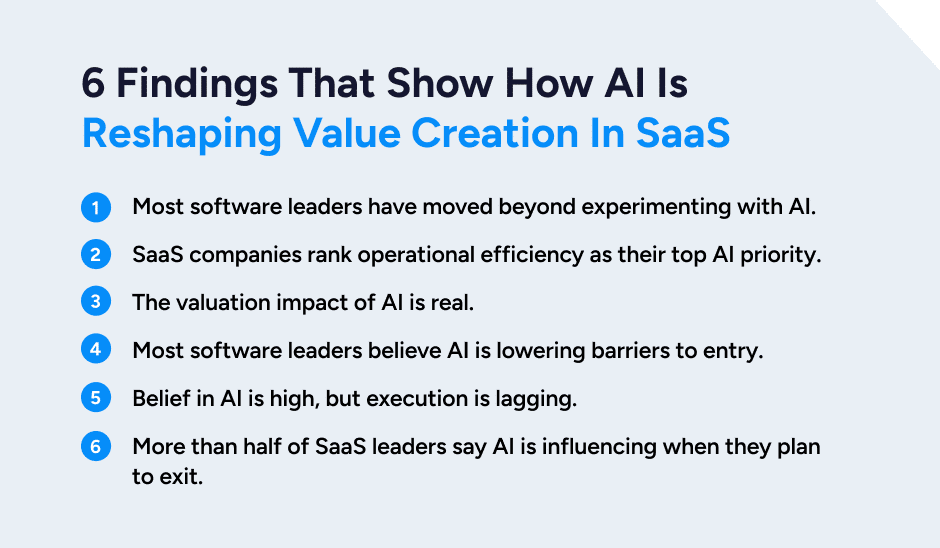
Takeaway 1: Most software leaders have moved beyond experimenting with AI.
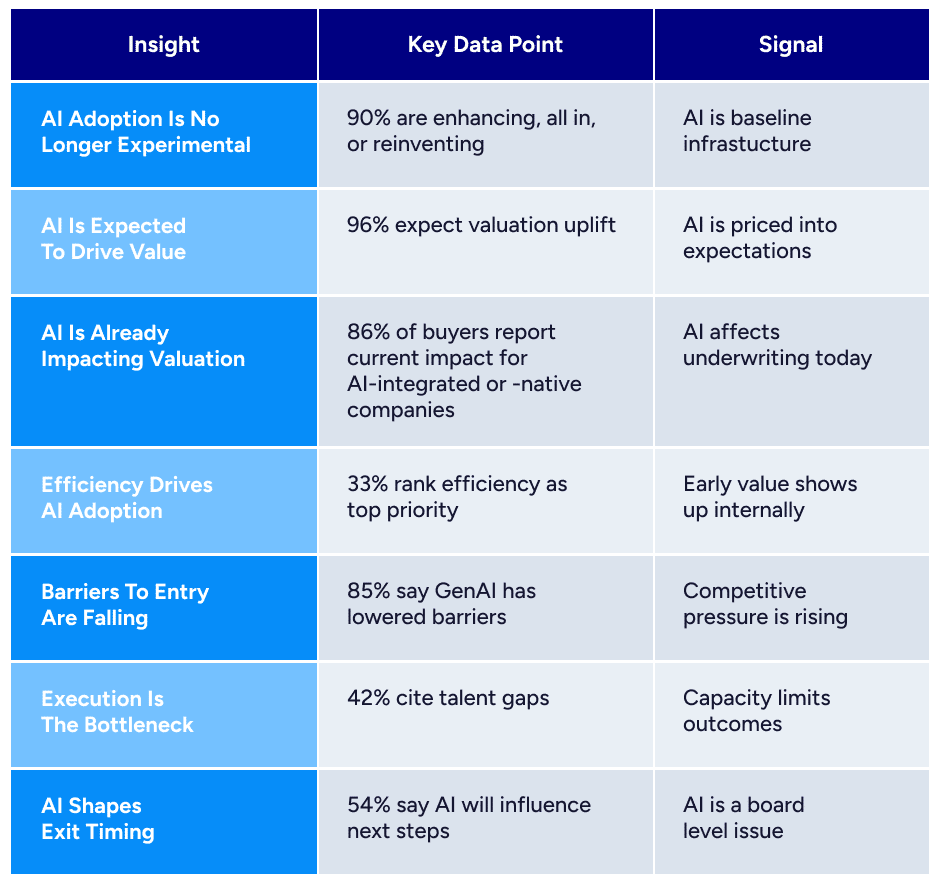
AI is now viewed by most SaaS leaders as a core strategic priority. Ninety-three percent of respondents rate AI as extremely or somewhat important to competitiveness, with consistent agreement across all ARR bands and funding structures.
Adoption levels reinforce this. Nearly 90% of respondents describe their AI posture as “enhancing,” “all-in,” or “reinventing,” indicating that AI is already embedded in workflows, products, or both for most companies. Only 8.2% remain in a monitoring phase, and fewer than 3% report no meaningful AI adoption at all.
Where results diverged: Private equity-backed companies were more likely to be “all in” or “enhancing” their operations with AI than bootstrapped or founded-funded companies were. When the right foundation exists, PE-backed companies are often more willing to aggressively accelerate AI initiatives to defend position, expand margins, and compound value during a hold period.
Bootstrapped founders often operate with deep conviction in their product and market, which is essential to building enduring companies. But that same conviction can delay recognizing how quickly AI-enabled competitors or substitutes can emerge as barriers to entry fall.
Takeaway 2: SaaS companies rank operational efficiency as their top AI priority.
When asked to prioritize AI investment, respondents most frequently pointed to internal leverage. Operational efficiency and workflow automation ranked as the top AI investment priority; product features/differentiation followed closely behind.
SaaS leaders are using AI to improve productivity, engineering speed, and internal support functions rather than immediately embedding AI into the product itself. These use cases tend to deliver faster, more measurable returns and require less customer-facing risk, making them a natural starting point for AI adoption.
Respondents ranked their AI investment priorities as:
1. Operational efficiency
2. Product features and differentiation
3. Sales and marketing
4. Customer success and retention
5. Data infrastructure
Where results diverged: We saw only small differences between revenue bands and company funding types. For example, the largest ($50M-$100M) and the smallest (under $5M) placed customer success and retention above sales and marketing acceleration in priority. Founder-funded businesses were more likely to prioritize using AI in sales and marketing acceleration over customer success and retention efforts.
Takeaway 3: The valuation impact of AI is real.
Confidence in AI’s valuation impact is nearly universal. Nearly 96% percent of SaaS leaders surveyed believe AI will somewhat or significantly increase valuation potential over the next two to three years, with 63% percent expecting a significant increase.
Notably, 86% of private equity and strategic buyers agree. They say that AI is already impacting valuations today; the same percentage expect that value bump to continue in the next couple of years for companies that have integrated AI or are AI-native.
AI is growing the gap between premium assets and the rest of the market. Buyers are evaluating whether companies can defend against AI-driven disruption and whether they can use AI to drive growth, efficiency, and competitive advantage. The message: Buyers are already pricing AI readiness, defensibility, and execution into valuation discussions.
Where results diverged: Two-thirds of private equity-backed companies expect AI to significantly increase valuation in the next two to three years; 72% of VC-backed businesses feel the same. This is compared with 51% of bootstrapped or founder-funded companies. PE- and VC-backed companies are also more likely to expect significant upside over the next two to three years. This reflects how institutional buyers are underwriting AI readiness earlier in the process.
Takeaway 4: Most software leaders believe AI is lowering barriers to entry.
AI has accelerated competitive pressure. Eighty-five percent of respondents believe that generative AI is lowering barriers to entry. When asked about long-term risk, respondents most frequently cited higher buyer expectations and valuation pressure (33%), followed by commoditization and loss of differentiation (21.7%).
More than half of SaaS leaders told SEG that AI-native startups don’t pose a serious threat; they believe they can adapt and compete.
On the other hand, most strategic and private equity buyers (85%) see commoditization and loss of differentiation as the key risk associated with AI. AI makes it easier to build software quickly, but harder to sustain defensible differentiation. Buyers are focused on what cannot be easily replicated, including proprietary data, workflow depth, domain specificity, and intelligence that compounds with use. The risk for SaaS leaders is complacency, assuming adaptability without investing in true reinvention, which is what the market is looking for.
Where results diverge: Smaller companies were most likely to name commoditization/loss of differentiation as a risk, with 44% of the $5M-$10M ARR group putting it at the top of their concerns. Companies with $25M+ in ARR were more likely to cite higher buyer expectations (valuations) as the top risk. Commoditization fell to a distant second for larger businesses.
Takeaway 5: Belief in AI is high, but execution is lagging.
Sixty-one percent of buyers expect future targets to be meaningfully AI-driven within a year, with core differentiation or go-to-market strategies built around AI capabilities. But two-thirds said they only see limited AI adoption in the companies they’re currently evaluating for investment.
What this data says is that the direction of travel is clear, but execution has not caught up. What’s standing in the way?
Forty-two percent of SaaS leaders cite lack of technical expertise as the biggest challenge to building AI into their business. By comparison, only 17% point to budget constraints. This highlights an execution gap. Most SaaS companies are constrained by people, architecture, and bandwidth, rather than a lack of willingness to invest.
Where results diverge: The largest companies ($50M+) were by far the least likely (2%) to say that AI has an “unclear ROI or business case.” Instead, lack of technical expertise, and concern that “hype is outpacing reality” were the biggest challenges for that group. Companies in the $10M-$25M range were most likely to cite “unclear ROI or business case” for ROI as a hurdle.
Takeaway 6: More than half of SaaS leaders say AI is influencing when they plan to exit.
AI is not a background consideration in strategic planning. More than a third of respondents are considering accelerating an exit due to AI, while 21% say they are delaying an exit until their AI adoption is clearer. Nearly 40% say AI has had no impact on exit planning.
Where results diverge: Companies approaching institutional scale (above $50M) were the most likely to report AI-driven exit acceleration. The other largest group considering accelerating an exit due to AI: the $5M-$10M range. Perhaps not surprisingly, companies with less than $5M ARR were the only group to say (58%) that AI has not influenced their exit thinking, possibly due to greater autonomy or already being AI-native.
This indicates that AI is shaping M&A strategy in all directions: smaller legacy firms exiting before they fall behind, larger incumbents seeking to sell while valuations remain favorable, and mid-stage firms pausing to modernize before their next move.
The Diligence Reset
AI is now a central part of how buyers assess risk and opportunity. In 2025, approximately 72% of SaaS M&A transactions referenced AI in the target company’s positioning, reflecting how quickly AI has become embedded in product strategies and buyer expectations across the market.
Public market performance reinforces this. Results in the SaaS Index showed meaningful dispersion, with returns concentrated in the top quartile of companies. While the broader index declined, the top quartile delivered roughly 6% year-over-year gains, driven by businesses tied to mission-critical workflows, data infrastructure, and AI enablement.
This highlights investor preference for SaaS companies that combine durable fundamentals with strategic relevance.
Turning AI Belief into Enterprise Value
The data in this report shows a market that broadly agrees on AI’s impact and importance, but one that is increasingly differentiating between companies that can execute and those that cannot.
As we explored in SEG’s The AI Reset: How SaaS Founders Can Reinvent, Defend, or Exit Stronger, founders face three paths forward:
- Reinvention
- Enhancement
- Exit
There is no single correct answer. Some companies will choose to reinvest and reinvent core workflows and products. Others will enhance existing foundations to drive efficiency, retention, and margin expansion. Some will decide that the best outcome is to exit while premiums remain and before competitive dynamics reprice their category.
What the data makes clear is that timing and execution matter.
Want to review the impact of your current AI strategy and map out your next steps? SEG regularly collaborates with growth-stage software leaders to evaluate AI readiness, market positioning, and strategic options. If you want help, reach out for a complimentary conversation.