An overview of our sell-side M&A services







How Buyers Are Evaluating Your AI Strategy

For years, software M&A diligence followed a familiar rhythm: market, growth, retention, product, team. But that playbook has changed.
Before strategic and private equity buyers dig into metrics or models, they now start with a different question, one that determines whether the rest of the process even happens:
“What is your AI strategy – and is it real?”
That message came through loud and clear in SEG’s recent webinar with private equity leaders from Five Elms, JMI Equity, and Waud Capital.
AI is no longer a late‑stage enhancement or a “nice to have” in software companies. It has become the first lens buyers apply when evaluating a company’s durability, competitiveness, and long‑term relevance.
If a software company can’t clearly explain and show evidence of its AI strategy, that can affect valuation, competitiveness, and even whether buyers decide to continue the conversation at all.
The data reinforces this trend. In SEG’s 2026 Buyers’ Perspectives Report:
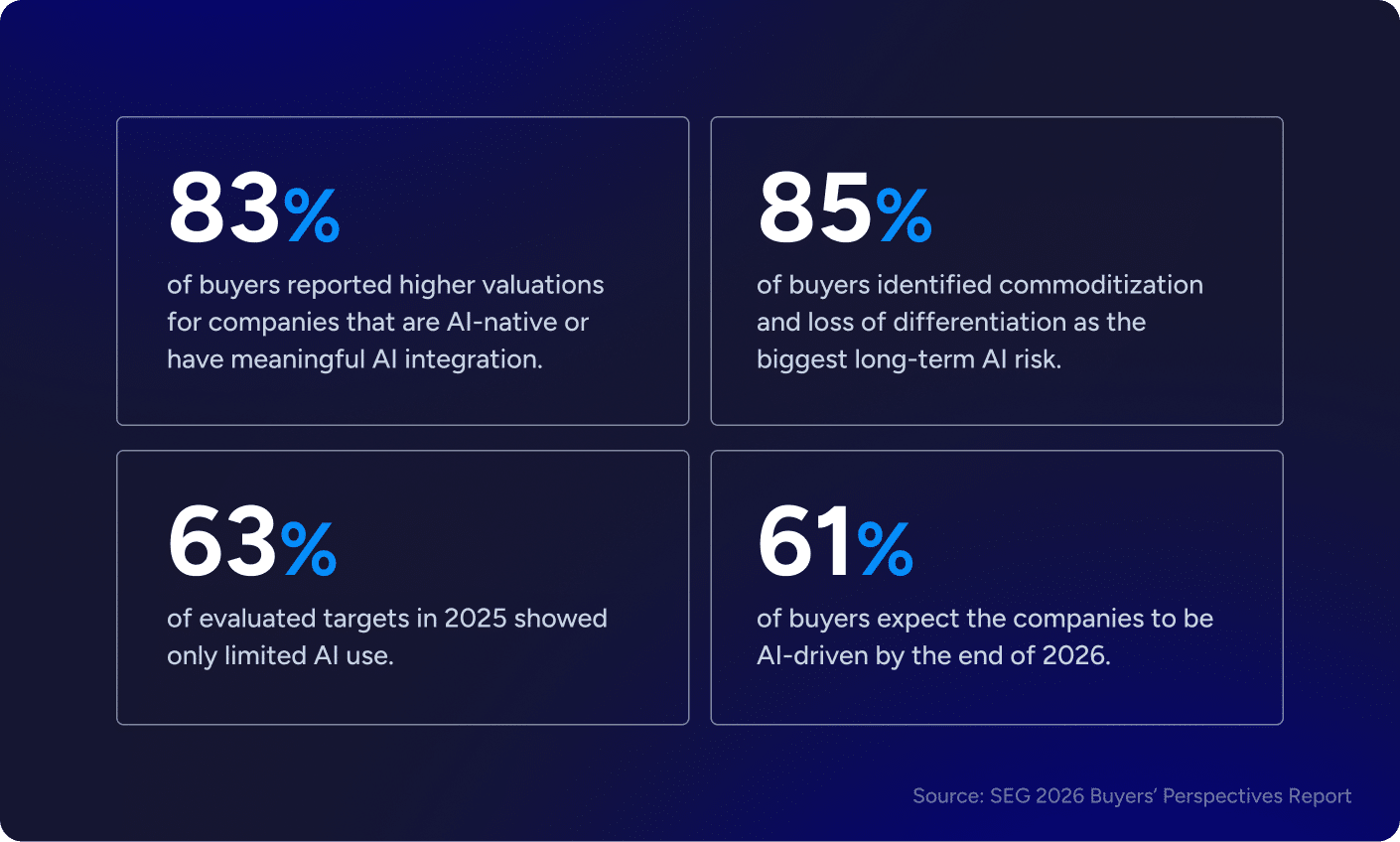
The gap between buyer expectations and operator readiness is widening, and it’s reshaping the entire diligence process.
How Buyers Are Using AI to Screen Deals Earlier
Buyers aren’t simply looking for AI features. They’re trying to understand whether a company can remain competitive as AI reshapes product categories, accelerates development cycles, and lowers barriers to entry.
Stephanie Schneider, a partner with Five Elms, explained that AI has become a core consideration in the due diligence process. Three forces are driving this change:
- AI accelerates competitive pressure.
Schneider pointed out that AI is “compressing time to value for new entrants,” putting pressure on incumbents who historically relied on switching costs and inertia to protect themselves. - AI changes the meaning of core metrics.
Retention, expansion, and margin profiles look different when automation, workflow redesign, and data‑driven insights become standard. What used to be a strong benchmark may no longer mean the same thing. Companies that already have “great products, mission-critical systems, regulated workflows, and deep data moats” are increasingly being differentiated by buyers on how they apply AI, according to Chase Thomet, a partner at JMI Equity. - AI introduces uncertainty, and buyers avoid uncertainty.
In M&A, uncertainty is often a deal killer. “Markets hate uncertainty,” Justin DuPere, co-head of Waud Capital’s Software & Technology Group and a partner at the firm, said during the conversation. And with AI, “We all got hit at the same time with something we are trying to grasp.”
This is why AI readiness has become the first filter in diligence. If you can’t answer the AI question, you may not get a second one.
What Buyers Now Look for First with AI
So, what does “AI readiness” mean in practice? It doesn’t necessarily mean having a fully monetized AI product or a cutting‑edge architecture. It means you can show where you’re going and prove you’ve started. Signs of this include:
A clear, leadership‑driven AI strategy
DuPere said that investors want to see how leadership thinks about AI “two, three, five years down the road,” and whether the company has a real framework for transformation.
A data foundation that can support meaningful AI
Put simply: no clean data, no real AI advantage. DuPere described data readiness as “a lot meatier” than tooling, emphasizing the need for structured, permissioned, secure data that can power proprietary insights. This is often the most scrutinized area of a software company’s operations.
Early, measurable use cases
According to Thomet, the best companies are “automating underautomated processes that unlock real value for their customers.” Buyers want proof that AI is already delivering outcomes, even if the initial scope is small.
Together, these elements form the new baseline. If you can demonstrate them, you move more quickly into deeper evaluation. Those that cannot often stall early in the process.
Why the Moats That Protected You Before May Not Protect You Now
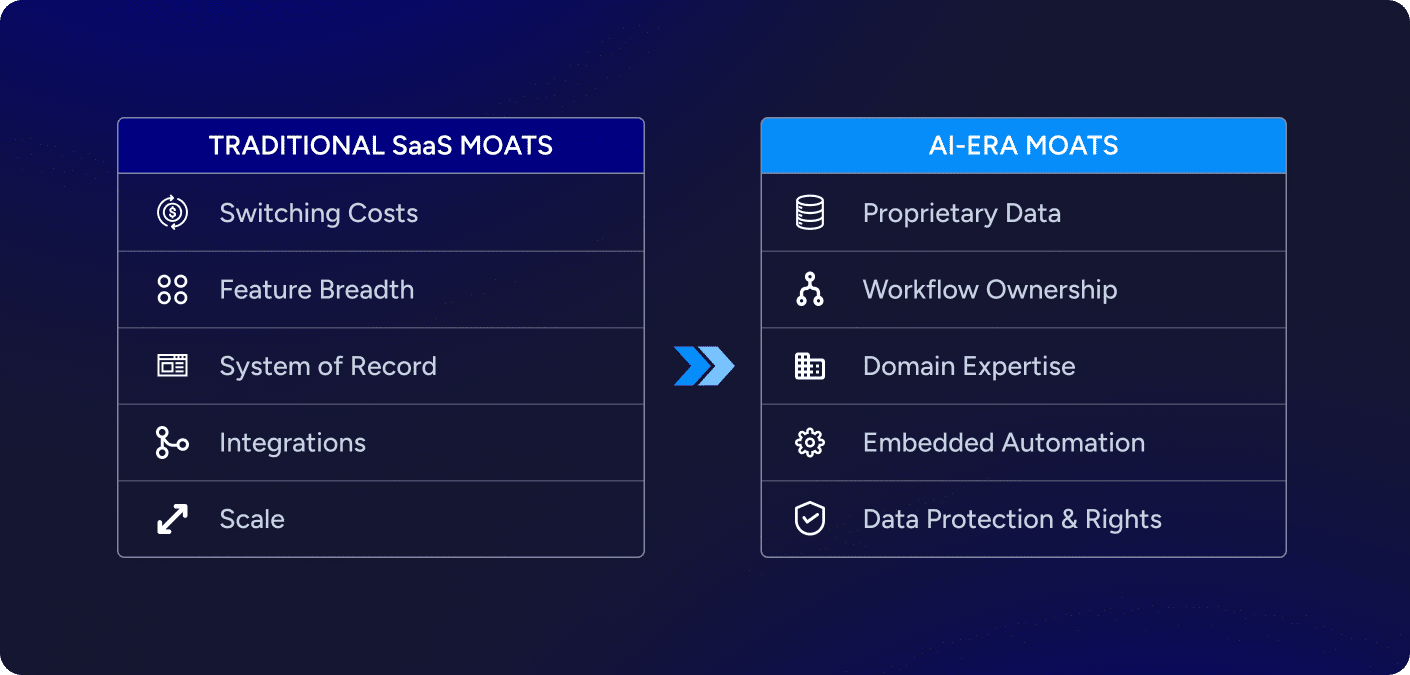
Traditional SaaS moats, such as switching costs, systems of record, and feature breadth, still matter, but they no longer guarantee long‑term advantage. What protected you before may not protect you now. It’s faster than ever for someone to catch up to you.
Buyers are now assessing defensibility through a different lens.
Thomet noted that the strongest companies have “real moats,” which could be regulatory complexity, proprietary data, or deep domain expertise. AI amplifies these advantages. Data rights, data structure, and data protection are central to evaluating long‑term defensibility, according to DuPere.
Buyers place the highest value on companies that combine:
- Proprietary data
- Workflow ownership
- Domain expertise
- Customer embeddedness
A company with rich historical data and deep workflow integration can build differentiated AI capabilities that are difficult to imitate. Conversely, companies without these assets face greater risk of commoditization, a concern reflected in the 85% of buyers who cite loss of differentiation as the top AI‑related threat.
Thomet, DuPere, and Schneider repeatedly returned to the idea that the best companies are those that understand their customers’ workflows deeply enough to automate meaningful tasks, not just add AI‑labeled features.
What Separates the Companies Moving Quickly From Those Getting Stuck
The diligence environment now mirrors the two‑speed dynamic shaping the broader software market. Some companies are moving quickly, while others are getting stuck early.
The fast lane: Companies with credible AI execution
Software companies with credible AI execution attract strong buyer interest, competitive processes, and premium valuations. They demonstrate:
- Durable fundamentals
- A clear AI roadmap
- Early proof points
- A data foundation that supports long‑term advantage
Thomet noted that these companies “go on offense” because AI shows up in both how they build product and how they operate.
The slow lane: Companies without a clear AI position
Companies may still have solid products and strong customer relationships, but without a credible AI narrative, they face:
- Longer processes
- Deeper scrutiny
- Valuation pressure
Schneider warned that companies without a clear AI narrative may “trade below” historical medians or struggle to transact at all.
Where the Market is Heading
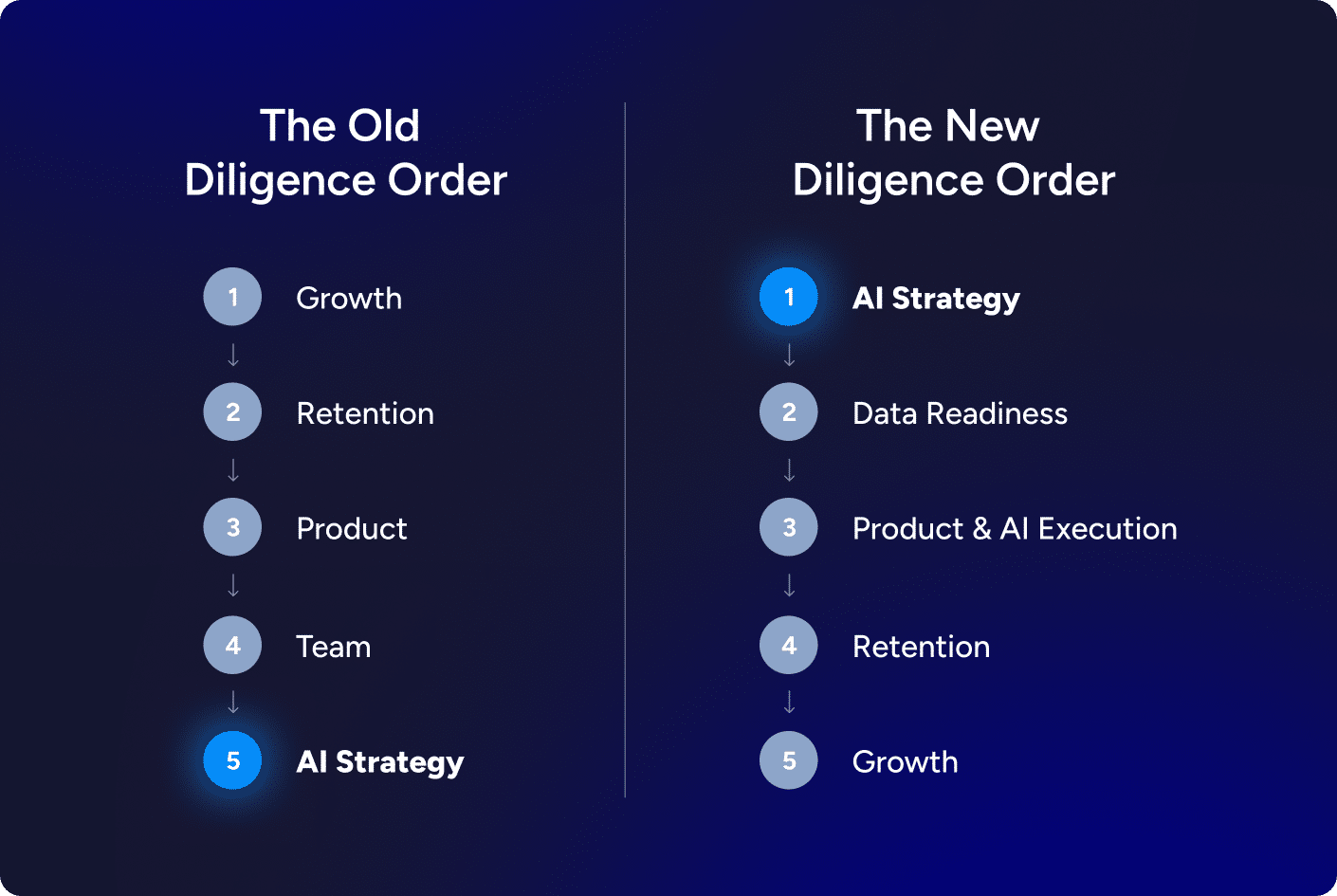
AI has become the opening question in diligence because it is now one of the clearest indicators of long‑term durability. It’s often the fastest way for buyers to decide if they want to keep going.
They want to understand how AI strengthens the business, how it accelerates value creation, and how it reinforces defensibility.
And they want to see evidence, not just intention.
The companies that stand out in this environment are not the ones with the most ambitious AI story. They are the ones that can show real progress, grounded in customer outcomes and supported by a strong data foundation.
In a market where expectations are rising and competition is selective, that combination is what moves a company from the slow lane to the fast lane and keeps it there.
Learn how you can reinvent, defend, or exit stronger in the face of the AI reset.
About the Author
Diamond Innabi is a Principal at Software Equity Group with more than 10 years of middle-market M&A experience advising software founders across sectors including energy, government, higher education, real estate, supply chain technology, and workplace management. Since joining SEG in 2014, she has led several successful transactions and is recognized for her expertise in valuations and strategic positioning for growth-stage software companies. Diamond frequently speaks on the software M&A landscape, including how AI is changing buyer expectations, valuation dynamics, and due diligence processes for SaaS companies. Connect with Diamond on LinkedIn.