An overview of our sell-side M&A services








SaaS Valuations Explained: A Conversation with Ben Murray, The SaaS CFO

For SaaS founders, the early years are about milestones: landing the first enterprise client, crossing $10M ARR, and expanding into new markets. But eventually, the question shifts from growth alone to value creation: How much is this company worth, and what will buyers pay for it?
Those questions can’t be answered by a simple multiple. Multiples rise and fall with the market, buyers weigh risk differently, and the metrics that matter most evolve over time. What doesn’t change is the founder’s goal: turning years of traction into enterprise value that investors recognize and reward.
Ben Murray, Founder of The SaaS CFO, spoke with SEG on what drives SaaS valuations. On his channel, they discussed the myth that strategic and financial buyers are different, when ARR or EBITDA matters most, the metrics that move the needle, and where founders go wrong.
The conversation points back to SEG’s 20 Factors framework, a structured lens to understand the levers buyers care about most.
Here are the takeaways from our conversation:
Strategic Buyers vs. Financial Buyers
It’s a common belief that strategic buyers will consistently pay higher multiples than financial buyers. Synergies and differentiation often give strategics room to stretch, but don’t oversimplify.
Private equity firms are flush with dry powder and under pressure to deploy capital. They have become highly competitive, particularly when a company fits their criteria: strong growth, high retention, defensible positioning, and clear opportunities to scale. In those cases, financial buyers can be just as aggressive as strategics.
Valuation isn’t determined by buyer type. The right process creates competitive tension between strategics and PE firms, and it’s that competition that drives exceptional outcomes.
Should Software Companies Be Valued on ARR or EBITDA?
Founders often ask whether their business should be valued on a multiple of ARR or EBITDA, but it depends on maturity.
- Earlier-stage SaaS businesses: Reinvestment into growth is expected, profitability often takes a back seat, and ARR multiples are the more relevant benchmark.
- Later-stage SaaS businesses: Once scale and cash generation kick in, buyers weigh profitability more heavily. EBITDA or free cash flow becomes a stronger lens because it signals discipline and sustainability.
Valuation is not a static formula. It shifts as a company matures and as the market evolves. Founders who understand where they fall on that spectrum can better tell their stories to buyers.
The SaaS Metrics That Actually Drive Valuation
Specific metrics consistently rise to the top of investor diligence when it comes to valuation. These align closely with what our 20 Factors framework identifies as the most influential value drivers. A few stand out as particularly critical:
Growth Rate: Top-line expansion is key, but investors want to see it paired with revenue quality.
Gross Revenue Retention (GRR) and Net Revenue Retention (NRR): Retention proves whether customers stay and expand. Increasingly, buyers view retention as equal to, or more important than, growth because it signals durability.
Unit Economics: Ratios such as LTV:CAC, payback periods, and composite measures like the Rule of 40 show how efficiently the business scales.
Gross Margins: High margins reinforce scalability and the long-term economics of the model.
What matters most is not just tracking these metrics but being able to explain them. Segmenting by customer type, product, or geography gives buyers confidence in forecasts and shows that leadership understands the business at a granular level.
No business is perfect. What matters is knowing where you’re strong, where the gaps are, and how you’ll address them.
The Biggest Valuation Mistakes Founders Make
Even strong SaaS companies can stumble in valuation. Here are several common mistakes founders make:
- Leading with multiples: Viewing valuation as ARR × a market number. In reality, multiples are the result of diligence, not the starting point.
- Messy financials: Disorganized P&Ls, unclear revenue recognition, or gaps in historical data create friction in diligence and invite discounts.
- Chasing headline deals: Benchmarking against splashy transactions that reflect unique circumstances undermines credibility.
- Ignoring quality of earnings: Buyers put a premium on GAAP alignment, reconciled KPIs, and trustworthy data. Without them, forecasts lose weight.
How Founders Can Prepare Now to Protect and Increase Valuation
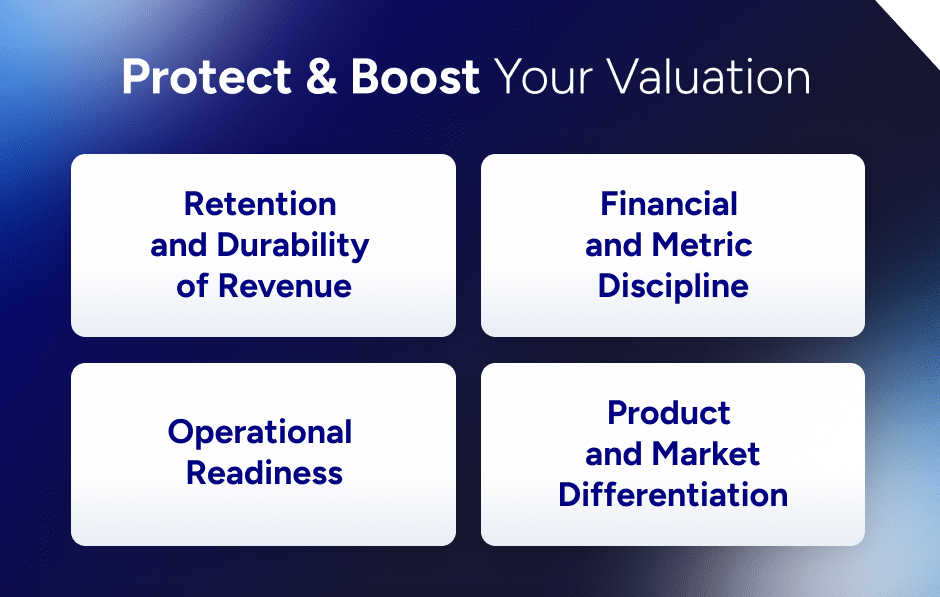
If valuation is the headline, preparation is the fine print, and it’s often where deals are won or lost. Getting your “house in order” early is the most effective way to protect and enhance value.
Founders should think about preparation across four dimensions:
- Retention and Durability of Revenue
Investors don’t just want to see growth; they want to see that growth is durable. Customer success, onboarding, and account expansion programs should clearly demonstrate that recurring revenue is predictable and renewable. Strengthening NRR and GRR early can mean the difference between an average multiple and a premium one. - Financial and Metric Discipline
Clean, trustworthy financials are the foundation of valuation. That means GAAP-aligned statements, accurate revenue recognition, reconciled SaaS KPIs (ARR, GRR, NRR, gross margin, LTV:CAC), and an ability to provide data by customer, product, or cohort. Historical trends matter as much as today’s snapshot. Gaps in data or messy P&Ls erode credibility and give buyers leverage to negotiate down. - Operational Readiness
Transactions often unravel in the details: missing contracts, unclear IP ownership, outdated signatures. Buyers want to focus on the business, not chase paperwork. Getting legal, HR, and compliance matters cleaned up early eliminates unnecessary friction at the 11th hour and keeps the conversation focused where it belongs. - Product and Market Differentiation
Metrics may start the conversation, but differentiation sustains it. Buyers pay premiums for SaaS companies with a clear edge in their category, whether through product features, defensible market positioning, or unique customer relationships. Founders who can tell a compelling differentiation story stand out in a crowded market.
Fundamentals (Not Formulas) Create Leverage in a Sale
Valuation is shaped by fundamentals. Founders who strengthen the areas buyers value most, such as growth, retention, profitability, efficiency, and differentiation, gain leverage in the process.
At SEG, our SaaS Scorecard and 20 Factors framework give SaaS leaders a structured way to benchmark performance against investor expectations and highlight where gaps may cost value. By examining both quantitative and qualitative drivers, we help SaaS leaders see where value is created and where it can be lost. Let’s talk.