The State of Industrial & Manufacturing Software Report

pillar-banner-arrow
TABLE OF CONTENTS
    Shadow-break-left

    Industrial and manufacturing software is entering a structural shift.

    Sustained volatility, workforce compression, and supply chain fragility are redefining how manufacturers evaluate technology and how buyers evaluate software companies serving the sector. This report examines where demand is durable, where value is concentrated, how AI and connected architectures are reshaping competitive dynamics, and what drives premium outcomes in today’s M&A market.

    Strategic Questions This Report Answers:

    • Is industrial and manufacturing software structurally expanding?
      We analyze macro forces, policy tailwinds, and operational volatility to assess whether software demand is cyclical or structurally durable.
    • What are manufacturers prioritizing right now?
      From uptime and workforce reinforcement to real-time visibility and coordinated execution, we examine how buying behavior is shifting under sustained pressure.
    • How should you approach architecture and AI?
      We explore the transition from hierarchical systems to connected data ecosystems, and what Industrial DataOps, Unified Namespace models, and AI orchestration mean for product strategy.
    • Where do you sit in the industrial and manufacturing software landscape?
      We define the functional domains underpinning modern manufacturing and clarify how systems of record, operational platforms, and intelligence layers interact.
    • What are buyers rewarding in this market?
      We break down deal velocity, buyer mix, and category momentum to identify where strategic and PE-backed acquirers are concentrating capital.
    • What drives premium valuations in industrial and manufacturing SaaS?
      Using SEG’s 20 Factors framework, we connect retention, architecture, workflow depth, and growth efficiency to long-term enterprise value.


     

    State-of-Manufacturing-Report-PDF


    overlay-color
    image-arrow
    TABLE OF CONTENTS
      INTERACTIVE TOOL

      Want Is Your
      Company Worth?

      Begin Assessment

      Is Industrial and Manufacturing Software Structurally Expanding?

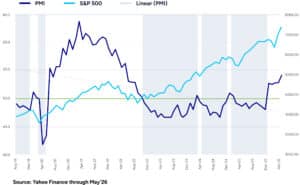
      Manufacturing output has been volatile since 2019. Trade friction, pandemic disruption, inflation, supply chain instability, and renewed tariff pressure have produced uneven PMI readings and cautious capital allocation.

      Yet industrial software investment has not retrenched in parallel.

      This divergence suggests that demand is being driven less by short-term production cycles and more by structural operational pressures.

      Several forces underpin that shift:

      • Workforce compression is persistent.
        A meaningful portion of skilled industrial labor is nearing retirement, and replacement pipelines remain constrained. Digital workflow systems, automation, and decision-support tools are increasingly structural requirements rather than discretionary upgrades.
      • Operational complexity is rising.
        Reshoring, supplier diversification, and multi-site coordination expand planning variables and increase execution risk. Software that unifies production, maintenance, and supply chain data becomes more valuable as complexity increases.
      • New capacity is digitally integrated by default.
        Infrastructure and advanced manufacturing investments are being built with higher baseline automation and connectivity expectations, raising the floor for software interoperability and data readiness.

      At the same time, budget scrutiny remains real. Platforms peripheral to core execution workflows face longer evaluation cycles. Systems that directly influence uptime, quality, throughput, and working capital continue to command prioritization.

      The conclusion is measured but clear: industrial software demand is structurally supported, though value accrues unevenly. Cyclical volatility affects timing. Structural labor, complexity, and digitization trends shape long-term direction.

      New-PMIChart

      Shadow-break-right

      What Are Manufacturers Prioritizing Today?

      Manufacturers are concentrating software investment on operational reinforcement rather than broad digital expansion. Purchasing decisions are increasingly tied to measurable impact on uptime, labor efficiency, and working capital.

      Several patterns define current buying behavior.

      1. Operational reliability over incremental optimization.
        Maintenance, production, and quality platforms that directly influence uptime and first-pass yield remain prioritized. Tools positioned as secondary analytics layers face more scrutiny unless tightly integrated into execution workflows.
      2. Workforce enablement and knowledge capture.
        Connected worker systems, digital work instructions, and assistive decision support are gaining traction as experienced labor retires. Software that reduces dependency on tribal knowledge aligns with long-term staffing realities.
      3. Real-time visibility across functions.
        Manufacturers are seeking clearer coordination between production, maintenance, inventory, and logistics. Platforms that contextualize operational data across OT and enterprise systems are favored over siloed reporting tools.
      4. Interoperability as a procurement filter.
        Architecture review is increasingly part of the buying process. Open APIs, clean integration paths, and data accessibility influence vendor selection alongside features.
      5. Stronger ROI justification.
        Budget discipline is evident. Buyers expect quantified impact, reduced downtime, and labor efficiency gains before committing capital.

      The signal for software leaders is pragmatic: demand remains active, but it is concentrated in platforms that demonstrate direct operational leverage and architectural compatibility. Narrative positioning carries less weight than measurable execution impact.

      Shadow-break-right

      What Are Manufacturers Prioritizing Today?

      Manufacturers are concentrating software investment on operational reinforcement rather than broad digital expansion. Purchasing decisions are increasingly tied to measurable impact on uptime, labor efficiency, and working capital.

      Several patterns define current buying behavior.

      1. Operational reliability over incremental optimization.
        Maintenance, production, and quality platforms that directly influence uptime and first-pass yield remain prioritized. Tools positioned as secondary analytics layers face more scrutiny unless tightly integrated into execution workflows.

      2. Workforce enablement and knowledge capture.
        Connected worker systems, digital work instructions, and assistive decision support are gaining traction as experienced labor retires. Software that reduces dependency on tribal knowledge aligns with long-term staffing realities.

      3. Real-time visibility across functions.
        Manufacturers are seeking clearer coordination between production, maintenance, inventory, and logistics. Platforms that contextualize operational data across OT and enterprise systems are favored over siloed reporting tools.

      4. Interoperability as a procurement filter.
        Architecture review is increasingly part of the buying process. Open APIs, clean integration paths, and data accessibility influence vendor selection alongside features.

      5. Stronger ROI justification.
        Budget discipline is evident. Buyers expect quantified impact, reduced downtime, and labor efficiency gains before committing capital.

      The signal for software leaders is pragmatic: demand remains active, but it is concentrated in platforms that demonstrate direct operational leverage and architectural compatibility. Narrative positioning carries less weight than measurable execution impact.

      Shadow-break-right

      How Should You Approach Architecture, Data Ecosystem, & AI?

      AI adoption in manufacturing is accelerating, but durable value is determined by architectural positioning within the broader data ecosystem.

      Established systems of record and workflow platforms remain foundational, and in many cases are best positioned to anchor this next phase of intelligent operations.

      Traditional industrial environments were built around hierarchical systems: ERP at the top, plant-floor applications beneath, and point integrations connecting them. Data moved in batches, and context remained fragmented. Intelligence was largely retrospective.

      That model is shifting toward connected, event-driven ecosystems.

      Industrial DataOps and Unified Namespace (UNS) approaches emphasize shared, real-time operational context across machines, MES, maintenance, quality, and enterprise systems. Instead of integrating application-to-application, platforms increasingly participate in a common data layer.

      For software companies, this has several implications.

      1. Interoperability is no longer optional.
        Open APIs, structured data models, and low-latency integration determine whether your platform can participate in broader operational workflows. Closed systems limit expansion potential.

      2. Data readiness constrains AI impact.
        The primary barrier to AI adoption is not algorithm availability. It is inconsistent data, poor contextualization, and weak workflow integration. Predictive and prescriptive systems only compound when data integrity is high.

      3. AI differentiation is moving closer to execution.
        Early adoption centered on dashboards and analytics. Current momentum favors assistive systems embedded within maintenance, production, and quality workflows. Emerging orchestration models aim to coordinate decisions across multiple operational domains, though adoption remains measured and human-supervised.

      Industrial AI capability typically progresses through stages:

      • Perception (defect detection, anomaly monitoring)
      • Predictive intelligence (failure forecasting, yield modeling)
      • Assistive systems (copilots embedded in workflows)
      • Coordinated decision support (cross-system optimization)

      Most manufacturers remain in the early stages. Competitive advantage emerges when intelligence meaningfully influences daily execution rather than reporting after the fact.

      The strategic question is architectural positioning:

      • Are you a system of record?
      • A data infrastructure participant?
      • An execution-adjacent intelligence layer?
      • Or building toward orchestration?

      AI amplifies strong architectural foundations. It does not compensate for fragmented data or shallow workflow integration.

      Shadow-break-right

      Where Do You Sit in the Industrial & Manufacturing Software Landscape?

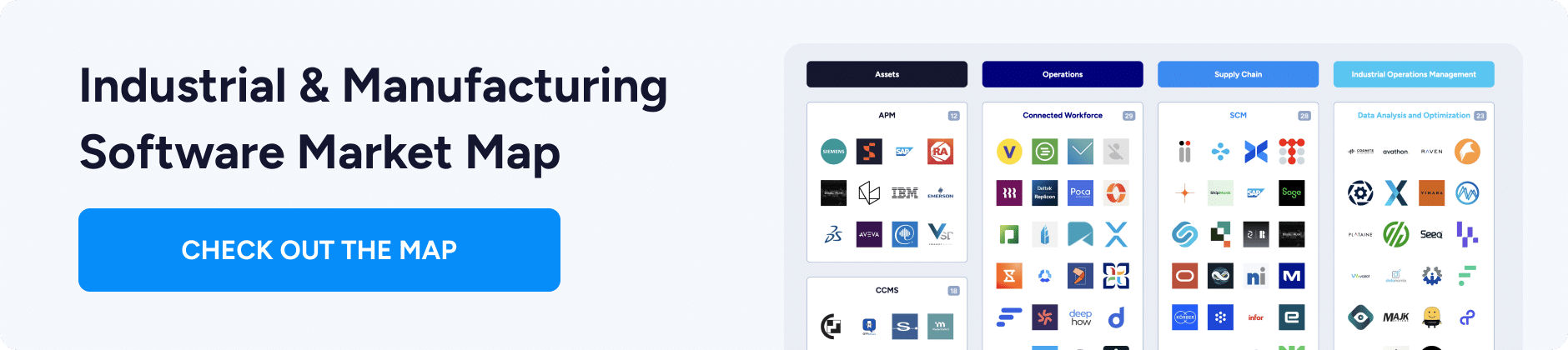
      Industrial and manufacturing software spans multiple functional domains across the operational lifecycle, from product design to plant-floor execution to enterprise coordination. Companies often operate across boundaries, but long-term defensibility depends on understanding your primary domain and adjacent exposure.

      We organize the landscape around six core domains that define how value is delivered in industrial environments.

      1. Industrial Operations & Intelligence Software
        Includes industrial data infrastructure, operational intelligence applications, edge integration and runtime environments, and emerging AI-native orchestration platforms.

        This domain connects and contextualizes operational data across OT and IT systems, enabling real-time visibility and performance optimization.

        Control over contextualized operational data increases cross-domain leverage and positions platforms closer to optimization and coordination layers.

      2. Asset, Operations & Workforce Management
        Includes EAM/CMMS, APM, MES/MRP, QMS, connected worker platforms, field service management, and related execution systems.

        These platforms manage daily production, maintenance, and quality workflows at the plant level. Execution-adjacent systems remain durable but must integrate cleanly into shared data ecosystems to avoid isolation.

      3. ERP
        Enterprise Resource Planning systems coordinate finance, procurement, and enterprise-level planning. ERP anchors transactional authority and often shapes integration standards across the broader stack.

      4. Supply Chain Management
        Includes supply chain planning, warehouse management, transportation management, and supplier coordination systems. Volatility has increased the need for tighter integration between supply chain planning and production execution systems.

      5. Product Design & Development Software
        Includes PLM, CAD, CAE, and simulation platforms supporting engineering and lifecycle management. Digital continuity from design through manufacturing is strengthening, increasing integration expectations across design and execution domains.

      6. Automation, Control & Digital / Physical Connectivity
        Includes IIoT, SCADA, PLCs, HMIs, DCS, and related control-layer technologies. This layer defines the quality and accessibility of operational data upon which higher-level intelligence platforms depend.

      For growth-stage operators, positioning clarity requires answering three questions:

      • Where is your primary domain of control?
      • How exposed are you to platform consolidation in adjacent domains?
      • Does your architecture enable expansion across boundaries, or reinforce category isolation?

      Strategic advantage increasingly accrues to platforms that understand their domain, integrate across others, and build leverage within connected industrial ecosystems.

      Industrial-Manufacturing-Software-Market-Map-CTA

      Shadow-break-right

      What Are Buyers Rewarding in This Market?

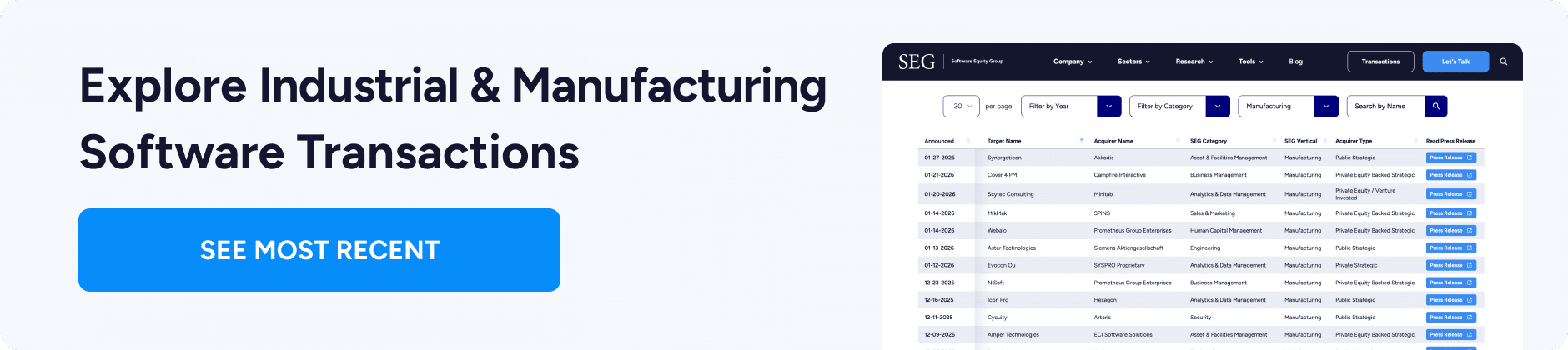
      Industrial & Manufacturing software M&A has expanded materially in recent years, with transaction volume increasing from 15 deals in 202 to 58 deals in 2025 representing roughly a 32% year-over-year increase from 2024. Strategic buyers, including PE-backed platforms, accounted for approximately 88% of total deal activity. The pattern of acquisitions provides a clear signal of where buyers see durable value.

      Several themes are consistent:

      1. Execution-adjacent platforms.
        Acquirers prioritize systems embedded in maintenance, production, quality, and supply chain workflows. Platforms that directly influence uptime, throughput, and coordination attract stronger strategic interest than standalone analytics tools.

      2. Data control and interoperability.
        Targets that own structured operational data or integrate cleanly across OT and enterprise systems are viewed as higher-leverage assets. Control of contextualized data enhances cross-sell potential and strengthens ecosystem positioning.

      3. Expansion pathways.
        Buyers favor companies with natural adjacency into complementary workflows, maintenance into reliability analytics, MES into production intelligence, SCM into planning optimization. Clear expansion vectors support platform assembly strategies.

      4. Demonstrated adoption and retention.
        Transaction outcomes increasingly reflect retention strength, expansion rates, and growth efficiency. Narrative positioning alone does not sustain premium valuations without evidence of durable customer usage.

      The dominance of strategic acquirers reinforces this direction. Many transactions support broader platform consolidation rather than standalone asset accumulation.

      The signal is practical: buyers reward platforms that are embedded in critical workflows, control meaningful data assets, and extend logically into adjacent domains. Narrow tools without defensible positioning face increasing consolidation pressure over time.

      Industrial-Manufacturing-Recent-Transactions-CTA

      Shadow-break-right

      What Drives Premium Valuations in Manufacturing SaaS?

      In industrial software, valuation premiums are driven less by narrative momentum and more by operational durability. Buyers and investors reward companies that demonstrate retention strength, measurable customer impact, and scalable expansion within complex environments.

      Several factors consistently influence outcomes.

      1. Gross Revenue Retention (GRR).
        High GRR signals mission-critical positioning. Platforms embedded in production, maintenance, and quality workflows typically exhibit stronger renewal performance due to switching friction and operational dependency.

      2. Net Revenue Expansion.
        Multi-site manufacturers create natural expansion opportunities. Companies that successfully land in one facility and expand across plants, regions, or adjacent workflows demonstrate scalable value creation.

      3. Workflow Depth and Differentiation.
        Products that influence uptime, yield, safety, or working capital directly tend to command stronger pricing power and strategic interest than peripheral tools.

      4. Architectural Scalability.
        Interoperability, clean integration paths, and structured data models reduce technical risk in diligence and improve long-term platform viability.

      5. Growth Quality and Capital Efficiency.
        Rule of 40 performance, disciplined customer acquisition, and durable LTV:CAC ratios remain central. In industrial markets, where sales cycles are measured, and deployments are complex, efficient growth signals strong product-market alignment.

      AI influences valuation only when it strengthens these fundamentals. When AI improves retention, accelerates expansion, or deepens workflow integration, it compounds enterprise value. When layered superficially, it does not materially alter outcomes.

      For growth-stage founders and CEOs, valuation strategy begins years before a transaction. Domain positioning, architectural decisions, retention dynamics, and expansion pathways shape long-term optionality far more than market timing alone.

      In this market, premium outcomes accrue to platforms that combine operational indispensability with scalable, defensible growth.

      Schedule-a-Strategy-Discussion-CTA

      Shadow-break-right

      From Founder to Exit: An Industrial & Manufacturing Software Transaction

      Building an industrial software company is rarely linear. It requires navigating long sales cycles, complex customer environments, and the responsibility of supporting mission-critical operations. When the time comes to pursue a transaction, founders face a different challenge: articulating strategic value, aligning with the right buyer, and protecting what they have built.

      Paul Lachance, former CEO of Bigfoot CMMS, partnered with SEG through the sale of his manufacturing software business. His experience highlights the importance of preparation, positioning, and disciplined execution, and how a well-run process can honor the company’s legacy while unlocking the next stage of growth.

      Watch the Bigfoot Transaction Story >

      Founders who achieve premium outcomes typically demonstrate clear domain authority, strong retention, expansion within multi-site customers, interoperable architecture, rich data to drive superior AI and quantifiable operational impact. They also understand where their platform sits within the broader industrial software landscape, and how it complements strategic buyers.

      Preparation, clarity of positioning, and disciplined execution materially influence optionality and outcome quality.

      Frequently Asked Questions

      Is Industrial & Manufacturing Software a Growing Market?

      How Is AI Being Used in Manufacturing Software?

      What Drives Premium Valuations in Industrial & Manufacturing SaaS?

      Are Strategic Buyers Active in Industrial Software M&A?

      How Do I Position My Industrial Software Company for Acquisition?